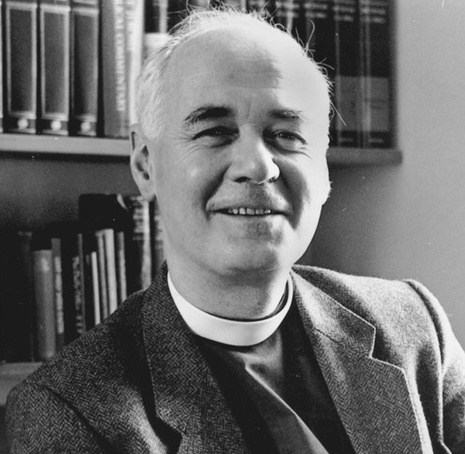
.
How can there be any meaningful interplay between physics and religion?
It is said that the universe was written in the language of
mathematics, yet the bible is a mere collection of words. Therefore how
can there be any meaningful interplay between physics and religion?
Preliminary Response: Both
Mathematics and The Bible are – at one level – collections
of symbols. But some symbols, if correctly interpreted, give a deep
understanding of reality (eg e= mc
2).
All religions seek to provide insights into the deepest levels of
reality, so it is almost inevitable that there will be some interplay
between the truths of physics and the truths of religion. But
equally, they are addressing very different domains of discourse
– religion necessarily involves persons and the relations between
them, whereas physics seeks to be impersonal. Therefore the
direct interplay will be sporadic. In John’s book
Quantum Physics and Theology – an Unexpected Kinship
he explores some of the remarkable parallels: deep reality often turns
out to be very different from what common sense would suggest. The
Trinity and wave-particle duality both seem “impossible”
but end up being the only coherent way to account for all the relevant
data in their respective fields.
John adds: Mathematics and words are both means for expressing concepts. In thinking about
how science and the Bible relate, it will be the conceptual level that is
important. I believe they have a complementary relationship.
The God Part of the Brain? I just read your book, "The Way the World
Is." I found it to be an
outstanding treatment of how science and religion an compliment each other. I know you have
written books more recently and I look forward to reading them.
Are you aware of a book
by Matthew Alper, "The God Part of the Brain"? In his search for God he found answers in the
scientific work done by Newberg and L'Aquila,
"Why God Won't Go Away." They
were two neurosurgeons who discovered that during prayer, meditation, and
spiritual experiences, a specific part of the brain in involved.
I think your
beliefs would complement theirs to answer a lot of theological and historical
question.
Preliminary Response: Thank you for
your appreciative email which I will pass to John. I don’t know if he is aware
of “The God Part of the Brain” – I am not.
There is a lot of research on the way in which
different parts of the brain interact with mental processes, but is almost
never turns out to be as simple as “an X part of the brain” because even if one region of the brain is
heavily implicated many other regions are involved as well, and the overall
behavior of the brain is almost certainly a function of “global” patterns which
are not at all well understood. The
“Premise” of the book that “For every physical characteristic that is universal
to a species, there must exist some gene or set of genes responsible for the emergence
of that particular trait.” doesn’t inspire enormous confidence: all human
beings are less than 1km tall and this is not because of genetics. It’s also pretty clear that belief in God is
not a physical characteristic. It must
be true that certain brain functions are involved in belief in God (as indeed
they are in belief in other minds or ability to do mathematics) and it may well
be true that some people are genetically more likely to believe in God/other
minds /do maths than others. This has very
little to do with whether the belief in God/other minds is true.
From what I can see on the web, Apler is a
self-educated screenwriter and his book has been described as “a loopy riff on
[Evolutionary Biology]’s standard explanation of religion” so I’m not very
optimistic about its intellectual quality.
John adds: I'm glad you found
The Way the World Is helpful. You might try
Quarks, Chaos and Christianity next. I do not know the book by Alper
that you mention, though I do know something about the work of Newberg and
d'Aquili. It is interesting but limited. We are embodied beings and all our
activity has a bodily component. When I do physics, a part of my brain lights
up; when I meditate on God another part of my brian lights up. This is not at
all surprising and, in itself, it implies nothing very significant about science
or religion.
How can mind function unless it is physical: maybe made of Dark Matter
1. How can mind invisibly function in the visible physical realm, unless it is also physical?
2. Is it possible that some aspects of
Dark Matter might account for this – there could be DarkChemistry, DarkBiology, and even DarkHomoSapiens?
Preliminary Response: To
respond to (2) first: since no-one knows what Dark Matter is, almost
anything is possible. But Dark Matter is subject to gravity
– that’s how we deduce that it is there. Therefore
any abnormal increase in the density of Dark Matter (such as would be
associated with a putative DarkHomoSapiens) would presumably have
measurable gravitational effects. This rules out many obvious
ways in which there might be a DarkHomoSapiens. And the whole area is
so speculative that it is scientifically impossible to address
meaningfully.
(1) is indeed a difficult problem, and the basic answer is
“nobody knows”. However the fact that nobody knows
how something happens doesn’t imply that it doesn’t happen:
if it did Science, as we know it, would be impossible
*. The
proposition:
(P1) that “anything that interacts with something physical must be physical”
is clearly a
metaphysical
position for which there can be no scientific evidence – unless
it is used as a definition of the term “physical”
which is admittedly tricky to define, but would then make the assertion
vacuous. However there are serious problems with (P1). To
mention just a few:
a. It is clear that mathematical constructs (like
Fermat’s Last Theorem) are not physical, but many theorems have consequences in the physical world
b. It also seems clear that propositions (like F.L.T. or P1
above) exist, and although they can be represented in the physical
world, their existence is not conditional on any particular
representation. The whole of logical thought depends on the fact
that there can be many different representations of the same
proposition or idea, so it’s pretty clear that ideas are not
physical. Yet it is also clear that ideas influence behaviour,
and that the physical world can influence ideas.
c. Insofar as we know anything, we know that we have a mind and that
our mind can influence our behaviour, although the existence of other
minds, like the existence of God, can not be “scientifically
proven”. Minds have ideas, and it’s pretty
clear that Minds are not, in themselves, physical. Of course our mind
is closely bound up with our brain, but the very fact that we can use
such language shows that the mind and the brain are not logically
identical. If it were true that (for example) “your mind is
completely determined by your brain” this would be an empirical
fact. But it seems logically impossible to devise an experiment
that could demonstrate this.
d. Lucas’s Theorem (due to
John Lucas)
proves that, if some human minds are capable, in principle, with the
aid of a sufficiently powerful computer, of understanding a Gödel
Proposition in any deterministic logical system, then at least those
minds cannot be completely modeled by any deterministic logical
system. This provides strong evidence that minds are not
logically determined by their brains.
John (Polkinghorne) uses the phrase “active
information” and points out that modern science strongly suggests
that the behaviour of complex systems is under-determined by normal
physical laws. He also advocates “dual-aspect monism”
under which object have both physical and mental aspects. There
are hints from the work of leading evolutionary scientists like
Simon Conway-Morris and
Martin Nowak
that the processes of evolution (in the broadest sense) have a role in
intermediating between “active information” and
“physical stuff”. It seems likely that these questions will
be better understood in 20 years – although it seems very
unlikely that we will ever fully understand the relationship of the
mind and the body.
* This was actually a big issue at the dawn of modern “Natural Philosophy”.
Locke
famously
wrote that he "suspect[ed] that natural philosophy is not
capable of being made a science" – words that many people today
would find incomprehensible.
John adds: Dark matter is important cosmologically but I do not believe
that it helps us understand the nature of mind (after all, it is matter
and it is invoked to understand the nature of galaxies).
Divine Interaction - an objection Having
reading some of John's work about his theory of divine interaction with
the world, I understand his theory to be more or less the following (an
admittedly brutal summarization): taking critical scientific realism as
a starting point, one moves on to hold the epistemology and ontology
are very close, if not exactly the same. Thus, when one encounters
epistemologically unpredictable systems
a la Prigogine, he can suspect them to be ontologically indeterminate and thus a possible point of divine interaction.
However, the theory hinges drastically on the equation of
epistemology and ontology and its application to these types of
systems. I believe
Arthur Peacocke
once asserted (either in a book or video interview) that although the
systems in question are epistemologically indeterminate, they are still
ontologically determinate and thus not fit for locating a divine-world
interaction point (he went on to espouse his theory of top-down
causation on analogy with the mind-body relation). Indeed, it seems to
me that Polkinghorne's theory is vulnerable to these types of
assertions that epistemologically indeterminate does not equal
ontologically indeterminate, and I am wondering how either you or Dr.
Polkinghorne respond to them?
Preliminary Response: John
takes the critical realist view that “epistemology models
ontology”. It is always possible that a system could be
epistemologically indeterminate and ontologically determinate, but it
is very hard to see how one could get adequate evidence that this was
the case. Remember that is part of John’s worldview is
Dual-aspect monism and the view that things in the universe behave like
machines in wholly predictable ways only when you have set up
experiments very carefully to ensure that they do so (and even then
there is always the rider “except in exceptional
circumstances”. However carefully the experiments in
SLAC
are set up, they won’t behave well in an earthquake. Having
in my 20s & 30s been a computer scientist and been involved in
actually trying to make electronics behave like a machine, I always
think the idea that “everything in the universe is a
machine” is rather ludicrous.
Asynchonous analogue systems are always going to have
indeterminacy. Consider an And-gate which will give an output of
1 if input A and input B are 1 and 0 otherwise. Suppose A goes
from 0 to 1 at t=0 and from 1 to 0 at t =x. Suppose that B goes from 0
to 1 at t=y. A simple continuity argument shows that there will be a
critical interval of values of y (y
1-y
2 say, probably somewhere near x)
whereby if y<y
1 the gate will output 1 and if y>y
2 the gate will
output 0 but within this interval it is uncertain what the gate will
output (at least within a defined time period). Similar arguments apply
to the amplitudes of the signals. If the system is sufficiently complex
(far below the complexity of the brain say) then there will be
situations where the effects of such uncertainties, however tiny, will
grow exponentially.
Peacocke was of course a biochemist so didn’t have to grapple with these issues at first hand.
John adds: Physics by itself is
not sufficient to determine the nature of causality (the fact that
there are deterministic and non-deterministic interpretations of
quantum theory makes the point) but it requires also an act of
metaphysical decision, which has to be defended for metaphysical
reasons. I choose the realist option of aligning epistemology and
ontology, not least because it affords the best metaphysical option to
accommodate adequately both human agency and divine agency. It is
important to recognise that the idea of top-down causality is not
unproblematic and its plausibility requires and analysis of caustal
structure to ensure that there is a genuine openness to allow its
operation in addition to bottom-up effects.
Stenger and Hitchens I was wondering if you have read two books:
God, the Failed Hypothesis: How Science Shows That God Does Not Exist, by Victor J. Stenger. And the second:
God is not Great: The case against Religion
by Christopher Hitchens. I would like to know what you think of these
books. Has Prof. John Polkinghorne read them? Could you let me know and
tell me what he thinks? Has God been discredited in these books? Are
they persuasive?
Preliminary Response: No, but I
have seen Stenger’s presentation on his website and I have heard
Hitchens speak on the topic. Stenger and C Hitchens both seem to
generate a lot more heat than light.
Hitchens doesn’t even pretend to be a scientist or a philosopher.
Stinger did some marginally useful scientific work but his claims are
far too dogmatic. As for his suggestion that Anthropic Fine tuning is a
non-problem because of his simplistic program MonkeyGod that purports
to simulate universes and “show” that anthropic universes
are commonplace, I know of no serious cosmologist who takes this
seriously. Martin Rees’s “
Just Six Numbers” is a good
guide to the real science.
John adds: I have read several
of the books expressing the current outburst of militant atheism, but
not the two you mention. My impression is that they are polemical
rather than presenting reasoned arguments of a truth-seeking kind, and
that they largely depend upon attacking caricature distortions of
religious belief.
Maurice Wiles I
have just been reading the essay on divine Action by JCP in the book
'Religion and science', published in 1996. I realise that this is
not very recent, but still felt impelled to write this.
In the essay he is very dismissive of the view of
Maurice Wiles
(which I strongly share) that God creates and sustains the world and
that that is all we need to say - God's action in the world is both
prior and constantly present in everything that is.
JCP dismisses this as a "detached and indifferent a deity". But
there is no reason whatsoever for thus categorising the God in whom
Wiles ande I believe. She is not only our creator, he is a close
and caring presence, sharing our struggles in the world he has made
. The only adequate theology of evil is one that recognises that
in some ultimate (and obviously difficult) it is a part of God's world
and that it will be finally transformed.
This understanding of God in no way dodges theodicy: God is ultimately
responsible for the Holcaust, for children suffering, for all pain and
distress.
On petionary prayer he seems to want to have his cake and eat it. We
can do it - but it is really "your will be done", as indeed I believe.
At least in that essay JCP seems unable to move outside traditional
Christian ideas. Does he really think that using the simplistic
language of "God who raised Jesus from the dead" is still possible
– he must know complicated and difficult such a statement is.
It may be that there are parts of tghe site where this is all dealt
with. If so, I shall be delighted to be pointed to them.
Preliminary Response I don't
have a copy of that essay to hand, and I have not read Wiles*.
However John does comment on Wiles in some other books.
We of course agree that "God creates and sustains the world",
but this does not mean that we are compelled to Deism. The
Christian God clearly interacts with Creation in specific and decisive
ways, most importantly in the life, death and resurrection of
Jesus. John suggests that Wiles's deistic account arises from a
feeling that the integrity of modern science would otherwise be
breached, and that the modern understanding that the Universe is not
merely mechanical makes this stance un-necessary.
On prayer, the question is not whether it should end "thy will
be done" but whether God actually listens to His creatures and
considers their wishes and requests. As Jesus pointed out, a
loving God does not ignore the pleas of those He loves. Deists may
think otherwise of course.
The question is surely not whether someone is "able to move
outside traditional Christian ideas" but whether there are sufficiently
compelling reasons to reject, modify or re-interpret the clear teaching
of the church on certain topics. On evolution for example it was
immediately apparent to many Christian theologians (though not all)
that this was not incompatible with Christian teaching even though it
meant that parts of the Bible could no longer be read in their apparent
"literal" senses. John's views on omnipotence and omniscience
differ importantly from the traditional teachings on these
topics. But in many other cases, the retreats and compromises
that seemed necessary to liberal theologians in the 60s and 70s can now
be seen to be wholly un-necessary, and indeed leading to a
sub-Christian account of various key issues.
There have always been difficulties about the Resurrection -
Paul and his contemporaries knew perfectly well that people didn't
normally return from the dead (although of course Resurrection doesn't
mean resuscitation) - but if you can't use language like "God who
raised Jesus from the dead" it is hard to understand in what real sense
you are a Christian theologian. And since modern science shows us
a world in which over 90% of the universe seems to be made of "Dark
Matter" and "Dark Energy" of whose constituents we have no idea, it is
blindingly clear that there is far more to reality than the tiny
fraction (partially) understood by science.
* Nor did I realise until I looked him up that his son is the
brilliant mathematician who proved Fermat's Last Theorem.
John adds: I knew Maurice Wiles
and respected him as a Christian thinker, but I think he was mistaken
in taking a 'single action' view of God's creative act. We use personal
language about God (Father not Force) however stretched it must be,
precisely because we believe that God does particular things in
particular circumstances as part of a divine particular care for
particular creatures. The many issues you raise, such as the
resurrection, demand a careful and detailed response. If you want
mine, you will have to read at least a book or two, for example by
Gifford Lectures "Science and Christian Belief" (in N America, "The
Faith of a Physicist")
Randomness and Creation
I am a Christian professor on an American campus. I am continually
hearing that the fact that the sub-atomic world is random and this fact
denies a God as creator. My question is, “what effect would a
structured or organized sub-atomic world have had on creation.”
As water has unique properties that are necessary, is it possible that
a random sub-atomic world is what makes creation possible?
Preliminary Response: First of
all, the word “random” is somewhat slippery and hard to
define. In the context of Quantum Mechanics (QM), we can take it
as meaning “there is no physical way to predict with certainty
the outcome of an observation (where the effects of QM are
appreciable)” This of course does not say that there may
not be other, non-scientific factors at work in influencing the actual
outcomes. So it is perfectly possible that God might
“fix” the outcomes of these uncertain observations in such
a way as to conform with the overall probabilities given by the laws of
physics. However the idea that God tinkers with reality to hide
the true nature of the world seems highly implausible, and both John
and I are much more inclined to believe that the indeterminacy of the
fundamental physical laws reflects a deep fact about the nature of the
Universe: that God has created it with real freedom inherent in the
deepest level of creation. This seems to be part of God’s
answer to the seemingly insoluble problem of “how can an
omnipotent creator create a universe in which beings are free to choose
to love Him and each other”.
It’s worth raising a couple of warning flags here: although the
observations from measurements are probabilistic the Dirac Equation,
which governs how the wavefunctions evolve over time, is deterministic.
This is one of the factors that leads to the notorious
“measurement problem” of QM to which there is no agreed
philosophical or scientific answer (
Roger Penrose
for example has a conjecture that it involves gravity). John and
I (and most working scientists) favour the “Copenhagen
Interpretation” which essentially accepts that, in some undefined
way, a “measurement” is a fundamental operation which
forces the wavefunction to choose which state it falls into. However
the “many worlds” interpretation, which suggests that there
are an unbounded number of other universes in which the measurements
just come out differently, has a growing minority of adherents –
and seems to appeal particularly (though by no means exclusively!) to
atheists and admirers of science fiction. The implications for
such ideas as moral responsibility are mind-boggling.
To focus on your specific question: great scientists like Newton and
Maxwell
had no difficulty in combining a deep Christian faith with the idea
that the fundamental equations of nature that they were elucidating
were deterministic. However if the Laws of Physics were really fully
deterministic then it is very hard to see how true freewill could
exist though again many philosophers argue for a
“compatabilist” view that freewill and determinism can go
together, but this is not very compelling and seems to us to be
motivated by a desire to evade the dilemma that physicalism denies
freewill. However the “randomness” ,or more precisely
“uncertainty”, that seems to be at the heart of the
physical world does make it clearer how true freedom and freewill could
emerge. This is especially true if you combine the uncertainty at
very small scales with the effects of chaotic dynamics which can
magnify the effects of very very small changes as complex systems
develop over time.
John adds: Modern science
has come to recognise that the processes that can give rise to genuine
novelty have to be ‘at the edge of chaos’ where order and
disorder, chance and necessity, creatively interlace. Otherwise
things are either too rigid for anything really new to happen, or too
haphazard for novelty to be able to persist. The intrinsic
unpredictablities of quantum mechanics and chaos theory can be seen
theologically as gifts of a Creator whose creation is both orderly and
open in this way
Quantum Vacuum and Zero Energy
I have noticed on several forums and discussions, including some of the
Q/A, that there is talk ot the universe emerging from a "quantum
vacuum". Some persons will say that though it consists of energy, the
energy is actually zero because the negative and positive balances out.
Is this true and isn’t it simpler to say that the quantum vacuum
is itself a result of the big-bang? thanks.
Preliminary Response: At the
present state of knowledge, any statements about “before the big
bang” are inevitably conjectural and/or metaphysical. It is
certainly interesting that, on current formulations, the positive and
negative energies seem to balance out arithmetically, though given the
great uncertainty of the nature and identity of the
Dark Energy and
Dark Matter
that seem to be the major components of the Universe, that cannot be
regarded as a totally robust finding. However the Quantum Vacuum
is not “nothing” but an incredibly rich structure, teeming
with possibilities and energy (William Blake would have loved it).
It’s a bit more natural to talk about a Quantum Vacuum existing
before Big Bang than vice-versa, but in the topsy-turvy world of
cosmology, especially with the rococo speculations of String Theory,
almost any language crops up somewhere in the discourse. And
it’s almost all highly speculative.
Something from
nothing, and the Anthropic Principle How
can we say that in the beginning there was nothing and then there was
something when there was nothing from wich the something could come out
from? It seems impossible for the big bang to happen without the aid of
God. There was not even the the potential for the beig bang before it
was said to be made actual; it is simply a logically impossible
supposition, that something can explode out of nothing.
Second, are you aware of the arguments of the anthropic
principle? Do you think that Dawkins defeates it in the God Delusion?
What do you make of what he says, and what is exactly the force of the
anthropic principle, could you elaborate?
Preliminary response:
There are certainly grave
difficulties for Atheists in the Big Bang, which is one reason why it
was resisted for so long. They tend to reply that you have to
assume something - why not that (or the Laws of Nature/ the Quantum
Vacuum/ an infinite series of Big Bangs etc..)
The Anthropic principle is a big
topic which John (and I) have explored extensively. Dawkins
certainly doesn't defeat it in TGD, indeed one recalls the
comment
of John Barrow: “You have a problem with these
ideas, Richard, because you’re not really a
scientist.”
We've just posted some comments
on ID on the Q&A pages.
What about
intelligent design? Has John's thinking evolved from such
thinking or is his thinking different all together?
Preliminary
Response:
The basic problem with ID is that God is never spoken of as a
“designer” in the Bible: He is Creator and Father
and a
Father does not “design” his children.
It seems that Evolution is one of the principles, like Gravity, which
God has used to create the Universe: there is no more a conflict
between Evolution and Creation than between Gravity and Creation.
John adds: ID
also makes a
scientific claim of identifying molecular biological systems of
irreducable complexity, but I do not believe it has made its case.
It is not enough to consider a single system in isolation,
since
evolution works in an improvisatory way, coopting what has been useful
for one purpose to help acheive another. ID also seems
tacitly to
make the theological mistake that God, who is the creator and sustainer
of nature, would not be conetent to work through natural processes,
which are as much expressions of the divine will as anything else.
Entropy:
I have a question for the Rev Polkinghorne about
entropy.
I have two starting premises: (so that you can tell me if these are in
error!)
1. According to the 2nd Law of Thermodynamics, a closed
system tends towards disorder.
2. Observation reveals a universe of beauty, pattern,
complexity
and order, particularly in the natural world, where pattern appears to
emerge at every level. (actually I'm wondering if this is
true.
There is certainly chaos as well... but perhaps it's fair to say that
even chaotic systems tend towards pattern and order.. although is this
just about reducing energy?)
I've been interested in these ideas in considering the
'warfare
theodicy' proposed by many (most? all?) open theists. I guess
you
would describe yourself as an open theist? (or something
similar)
Do you believe in a world at war? Are there aspects of the universe
that support these 'warfare' ideas? (as I believe quantum mechanics
appears to support openness) I've been interested in what it
means to live in a 'fallen world' - in a world which at the physical
level is not how it was intended. But yet a world in which
God is
always at work revealing himself and working out his purposes.
For example, the two effects I've described above appear to
battle against each other. The 2nd Law tells us that disorder
should increase, but yet order and pattern emerge everywhere.
It
sounds like a cosmic battle in some ways, although I realise this a
simplistic way of understanding both aspects. As I understand it, the
physical universe runs in a way that means that everything eventually
runs down and everything is reduced to disorder and randomness,
(however, I understand that there's nothing 'spooky' or arbitrary about
the Laws of Thermodynamics, they just describe how energy
works).
But it is amazing that the universe is beautiful and bright and that
animals and plants tend towards order and complexity. Why do these
appear?
I'm not primarily interested in making an argument from
design,
etc. My main interest is in the idea of a world at war, and
what
that could mean in the physical universe.
I wondered if you had any insights on these
things. I
studied physics only to undergrad level and clearly my scientific
understanding and description is very clumsy. Have you
written
about these ideas in any of your books?
Preliminary Response: I'm
not familiar with "warfare theodicy" and a quick google leaves me
little the wiser. Although cosmic warfare is certainly a fairly
important theme in the Bible, it is hard to see it as much help in
theodicy. To answer "Why does God allow evil and suffering"
with
"because there is Cosmic Warfare with the Powers of Evil."
doesn't seem to get very far unless there is a good answer to: "why
does God allow the Powers of Evil to wage Cosmic Warfare" –
which
John and I find "deeply puzzling". It is in fact tempting to see "the
Powers of Evil" as emergent properties of the evil caused by
mis-applied human freewill, although this is highly speculative.
There are some puzzles about the 2nd law, but the standard
answer to how living systems can increase order is that they increase
order locally at the expense of greater disorder (technically, higher
entropy) globally. So for example plants take the very low
entropy of photons from the sun and turn it into low entropy life and
high entropy gasses. We are only beginning to understand how
higher order "emergent" properties come into being (Stuart Kaufmann did
some pioneering work on this, there is fascinating work under way by
Martin Nowak
about how evolutionary dynamics leads, under suitable conditions, to
cooperation and order, and
Denis Noble
has been developing the philosophical implications of systems biology)
and there is little doubt that a deeper understanding of what John has
called "active information" is one of the key challenges of the 21st
Century.
John adds:
Modern science has come to recognise that regimes in which truly novel
consequences can emerge are always "at the edge of chaos", that is:
their circumstances are such that order and disorder, chance and
necessity, interlace. Hence there is an inescapable shadow
side to great fruitfulness.
The idea
of Satan, or the Devil.
While I realize many thoughtful Christians (like C.S. Lewis) believed
in demons and the devil, and it's in Scripture, the concept has become
difficult for me to swallow. The "red guy with a pitchfork" is a poor
conceptualization, I know, but so is the idea that all human actions of
"evil" on this planet are somehow the end-products of his or his
invisible minions' tempations. Any thoughts on a solid,
modern
understanding (not medieval or Dante-esque) of who the devil is would
be helpful (why I feel the need for clarification on this matter is
anyone's guess).
Preliminary Response:
It's very
hard to know what to think about Satan, Demons and Angels.
The
Bible says little about them. Angels seem to be spiritual
beings
who worship God but are occasionally sent to be His messengers on
earth. The Biblical picture of Satan (which means "the
Accuser"
in Hebrew) seems to vary: in the prologue to Job (Job BTW is, roughly,
a Play and not intended to be "factual", but it is one of the most
profound books in the Bible) he's a kind of rogue courtier but Jesus
talks about him as the fundamental quasi-personal influence behind much
of the evil in the world.
When Jesus says, to Peter "Get behind me, Satan, for you do
not
judge according to God's ways, but men's" (Mark 8:33 & par) he
is
not suggesting that Peter is "possessed" by the Devil or that Peter is
not making these very prudent suggestions for his Master's safety of
his own free will. He seems to be saying that Peter is unwittingly
falling in with Satan's designs. So describing Satan as the
ultimate "force" behind the sin in the world does not mean that humans
are absolved of their responsibilities. But the Bible is clear that
there is a cosmic struggle going on and not just a human one.
It's tempting to use the language of Chaos Theory here and
make
the analogy between Satan and a "Strange Attractor" which is a
dynamical path (of non-integer dimension) that is not necessarily
actually reached by other dynamical paths in the system but whose
existence and characteristics influence the behaviours of the dynamical
paths that come near it.
John adds:
All I would add to
Nicholas's helpful response is that when one considers a terrible event
like the Holocaust, there are of course human factors at work (the
wills of wicked men, the social sin of unquestioning obedience to the
state, ordinary people's compromises and cowardice), but the weight of
evil involved is so great that I myself cannot rule out the influence
of some form of evil spiritual power at work. Where such a
power came from and why it is allowed to operate are, of course, very
perplexing questions.
What about James Lovelock's
ultra-frightening new prediction
on the effects global warming will have on the human population within
the next 60-some years. As I'm sure you know by now, he has predicted
that upwards of 6 billion people will perish by the end of the century
and what's left will be trying to stay alive near the north and south
poles. Your opinion on these warnings and how, as Christians, we should
feel about it would be much appreciated.
Response:
the "Revenge of Gaia"
predictions appear
to be scaremongering, although it is very hard to be certain of
anything long-term. It is very clear that climate change is a
serious problem, and that radical solutions will be required, some
involving social changes and some involving large-scale applications of
technology. For example, Lovelock has also proposed a very
interesting approach to helping "global cooling" with wave-operated
pumps. Christians should be engaged in these issues, without succumbing
to the Neo-Paganism that elevates the Environment into a
Godess.
Anything that poses serious risks to the lives of millions, or
billions, needs to be taken seriously as part of our duty to be
stewards of God's world.
Samaritans:
I read your article, "The Truth In Religion," which appeared in the TLS
and I would like to comment on a side issue that you mentioned in
it. You wrote: "When it [Dawkin's book] asserts that
Jesus’
call to love our neighbour referred only to relations between Jews
(despite this claim being in clear contradiction to the point of the
parable of the Good Samaritan), the only support quoted for this highly
questionable statement is a book written by an anaesthesiologist."
Perhaps you might consider reconsidering you reading of the
parable of the Good Samaritan? In his book,
History of the Samaritans
(Frankfurt am Main: Peter Lang, 1992), Nathan Schur writes:
"The
process of drawing apart [of Samaritans from Jews] was certainly a very
gradual one…In spite of some nasty name calling from both
sides
and some violent action on part of the Hasmonean rulers, the
responsible Jewish halakhic authorities continued to regard the
Samaritans from certain points of view still as Jews till late into the
second century AD…Jews still joined the Samaritans in one of
their last uprisings against the Byzantine government in 556
AD.
Thus the process of estrangement was a very slow one, spread over many
centuries and completed only a millennium after it had started."
In my own article,
Samaritans,
Jews and Philosophers.
Expository Times 113:5: 152-6 (2002), I wrote: "A Jewish writer would
never mention a Samaritan as an example of a gentile or generic human
being. It is true Jews and Samaritans had their differences
and
conflicts. So did the Northern and Southern Kingdoms of
biblical
Israel. The relationship of Jews and Samaritans to each other
was
quite dissimilar to that holding between Palestinians and
Israelis. A better (yet still obviously imperfect) historical
analogy might be to the relationship between Anglicans and the Church
of Rome.
If Jesus had intended to overthrow the particularity of Leviticus, he
made a poor choice in speaking of a 'Good Samaritan'. If only
Jesus had spoken of a good Greek or idolater! Then it would
be
reasonable to speculate that he meant, in this particular story, to
call for a universal ethic of love."
If you would like, I can email a copy of my complete article
to
you. I should mention that more generally speaking, I am in agreement
with your criticisms of Dawkins & co.
John says: I’m
interested in your scholarly comments on the Samaritans.
However
I think that Jesus’s choice of a Samaritan in the parable
implies
that he would have been seen as in less than a brotherly relationship
to the Jews. As to the contra Dawkins point, the admonitions in the
Torah to care for the stranger seem enough to make the point that he is
wrong to assert that there is no real concern for non-Jews.
Embryonic
stem-cell research. I
am only newly acquainted with Dr. Polkinghorne, having heard him speak
today at Belmont University in Nashville TN. He was brilliant
(stardust!) and I am filled with wonder. After the lecture he
allowed a few questions. One had to do with the morality of
embryonic stem cell research. Dr. Polkinghorne answered by
discussing at what point an embryo becomes a human person (at 14 days I
think). I would like to ask how the love principle
– that
God created a universe which allows beings to be and make themselves
– would address this issue. If the potential for
human life
exists in the embryo before 14 days, should love allow it to
become? I look forward to further exploring your website and
reading his books.
Thank you for your good work,
John says:
The embryo is human
life from the start, and deserves high moral respect because of that,
but I do not think that initially it has the absolute ethical status of
personhood.
Apparent wastefulness
of natural selection Does the
apparent wastefulness of natural selection go some way to discrediting
the idea that God is loving and merciful? How can a God of
life allow a creation to develop where so many species die in, often,
horrific and protracted suffering? I appreciate the
idea that life was given the freedom to "make itself" but still the
developmental process that leads to sentiency seems nonsensically
brutal.
Response:
Well “species” don’t suffer. Clearly some
higher
animals do, although we must avoid the “pathetic
fallacy”
of attributing human feeling to non-humans.
The
problem of pain – even when we eliminate the doubtful cases -
is
a real and serious one. But no-one has ever suggested a
better
way than Natural Selection to allow life to “make
itself”
indeed some suggest that it is the only possible way.
Vastness of the
universe Does
the sheer vastness of the universe make the inference of God based on
fine-tuning less compelling? Couldn't one argue that God
wasted a
lot of space (no pun intended) in order to create life?
Response: The
size of the universe is essentially a function of its age.
And we
need enough time to create 2nd generation stars, and then for life to
evolve. So c14bn years seems about right. In many respects
there
is no real difference between 14,000 years, 14m years and 14bn years:
they are all immense to us, and all equally comprehensible to God.
The fine tuning is of course about the fundamental constants of nature,
which (as far as we know) are the same throughout the universe.
Experiment as basis for post-Aristotelian
philosophy
The Wikipedia article about you includes this sentence, with reference
to your philosophical outlook: "Because scientific experiments work
very hard to eliminate extraneous
influences, he believes that they are thus highly atypical of what goes
on in nature."
My question is: Would you agree that at about the time of the
Reformation, the
synthesis with Aristotelian thought which had previously been achieved
by the Christian church through the work of, e.g. Thomas Aquinas, was
disrupted, not only with respect to the old
Aristotelian certainties’ (the sky wheels around the
earth,
bodies fall under gravity at a constant velocity etc.) but also with
respect to the Aristotelian theory of knowledge, i.e. “when
from
many notions gained by experience, one universal judgement about
similar objects is produced” (Aristotle,
Metaphysics, Book 1
Chapter 1, translation in Ackrill 1987) Isn’t the
epistemological basis for the empiricism of Locke and
later Hume just this ‘atypical’ probing by
experimenters,
from Bacon and Galileo onwards? And isn’t it most likely that
the
scepticism of Hume, and later Kant and twentieth century positivism
(which I think we both dislike), a response, not to anything in the new
philosophy which necessarily replaced Aristotle, but to the severe
pressure put on it by a society which includes religious believers who
insist on retaining ideas (e.g. that mind can exist independently of
brain) for which there is no objective evidence?
Preliminary Response: I
don't
want to get drawn into Aristotle and Locke. But I don't think
there has ever been severe pressure put on science by religious
believers - until Darwin almost all the great scientists were religious
believers and it's really only in the 20thC that this has not been the
case - although of course there are many great 20th and 21st C
scientists who are religious believers as well.
It is obviously self-refuting to hold that "you should only believe in
ideas for which you have objective evidence" and it is clearly
logically possible for the mind to exist independently of the brain
(otherwise AI would be impossible by defintion) - the actual
relationship between human brains and the minds associated with them is
certainly intimate and certainly un-clear.
John adds: I
agree that science
considers a particular kind of experience (impersonal) encountered
usually in special circumstances (experiments). If you want
to
know what I think about epistemology you could read Ch 2 of
Science and Christian Belief
(SPCK) aka
The Faith of
a Physicist, and for my assessment of the acheivements of
physical science, ch.2 of
Exploring
Reality (SPCK)
Mandel
experiment
In your opinion, does the Mandel experiment carried out at the
University of Rochester, in which the mere threat of obtaining
information about which way the photon went, favour either of the two
alternative explanations of the collapse of the wave packet, ie the
apparatus itself causing the collapse, or the possibility of our being
able to track the photon's path?
john says:
My personal view is
that the Mandel experiment illustrates the counterintuitive character
of quantum theory but it does not require commitment to a particular
interpretation.
What can people
believe and still be Christians? I
have read some of the questions and answers on this site and found them
rather disappointing. You seem to be trying to reconcile the
differences between science and religion by concentrating on what
scientists and religious believe. I think this approach misses the
point. Both scientists and religious believe astounding, wonderful and
counterintuitive things. There really is no conflict here. Where the
huge gulf lies is in the reasons for belief.
Leaving aside such esoterica as string theory,
scientists
require evidence whilst religious sometimes seem to make a virtue of
believing the unlikely in spite of the evidence. This is where the true
difference lies and it is a very profound one.
Speaking for myself I find the scientific viewpoint immensely
more satisfying. If I want a sense of the numinous I would rather get
it by contemplating the implications of quantum entanglement than by
thinking about angels. My sense of wonder is only increased by the fact
that I could go to any suitably equipped lab and see the Aspect
experiment performed whereas I doubt you could show me an angel. (I
suppose this analogy is not exact, you could show me some phenomenon
for which you thought the most likely explanation was angels. I would
probably be forced to disagree with you)
What I did find interesting about the site is that it made me
realise that I don’t actually know what Christians do
believe.
You yourself seem to have some quite traditionalist beliefs about
judgement and salvation and yet you have a sophisticated understanding
of evolution and believe it to be true. I have never met a Christian
who actually understood evolution before and I suspect your position
(and even more so that of John) is an unusual one.
So I finally come to my question. What can a person believe
and
still belong to the set of Christians. Is the Rev.Ian Paisley a
Christian? Is the Pope? Is your unbelieving Bishop Spong? There is
clearly a very wide set of beliefs encompassed here! Much wider than
you would find for example in a group of people who called themselves
“Zoologists” or “Physicists”
I suspect you are going to say something along the lines of a
Christian must believe the Nicene Creed. I am afraid that much as I
would like to I do not. I understand what it means, I learned it in
childhood and I now consciously and of my own free will reject it. The
flames await. How does this sit with your conscience?
Preliminary Response:
The issue
is not "what must a Christian believe" but "in whom must a Christian
believe". Christian faith is not belief in a set of abstract
propositions but faith in a living God. Christians must believe and
trust in Jesus Christ. Now if you believe and trust in
someone
you will generally believe what they say and do what they ask: it is
therefore very hard to see how someone who does not believe that the
resurrection actually happened (say) could really be a
Christian.
Historically, as you say, people have tried to delimit the range of
theologically acceptable beliefs by the Nicene Creed, but the truth is
that only God knows whether someone really believes and trusts in Jesus.
Clearly all human beings are misguided to some extent, and
in my
personal view probably Spong is more misguided than Rev Ian Paisley who
is more misguided than the Pope (even Catholics BTW don't say that the
Pope is infallable always). It is not my business to draw dividing
lines - except to say that unquestionably the Pope is a Christian, and
I know of no reason to doubt that Ian Paisley is. You can of
course be a Christian and a very mistaken theologian. Almost
all
mainstream Christians in Europe accept evolution as we accept gravity -
of course we don't accept that evolution implies atheism a la Dawkins
any more than we accept that Newtonian Mechanics implies atheism
a la
Laplace. Of the founders of modern evolutionary theory,
Mendel,
Fisher and Dobzhansky were all Christians and today at least three of
the world's most important contriubtors in this area: Simon
Conway-Morris, Francis Collins and Martin Nowak are quite visible
Christians.
It is a fundamental category mistake to contrast
"Scientists"
and "religious" - you might as well contrast "Scientists" and
"women". It may be true in some cultures that scientists are
much
less likely to be adherents to organised religions than the
general population, but that's rather beside the point: they have
historically been much more likely to be female.
Christians don't contemplate Angels much - we do contemplate
God
a lot. Quantum entanglement is, from our perspective, a bit like a
beautiful lake - wonderful indeed, but even more wonderful if you also
can contemplate the sea and understand the relationship between them.
John adds: I
believe that
religious faith is as much concerned with truth sought through
motivated belief as is science. though the kind of motivations
appropriate are necessarily different in character in the two cases.
Religious motivations are more akin to the sort of motivations that
lead us to trust our friends, that is they are attained through
trusting rather than testing. If you want to see a fairly detailed
exposition for my reasons for accepting Christian belief you might read
Science and Christian
Belief (in N.America entitled
The Faith of a Physicist)
Moses
and Genesis What do you make of this verse? John 5. Jesus
said:
46 For if you believed Moses, you would believe me; for he wrote about
me. 47 But if you don't believe his writings, how will you believe my
words?"
Moses is credited with writing Genesis.
Surely if we regard his writings in Genesis 1-11 as mere myths or
allegories then we're not respecting the Word? Genesis 1-11 is
foundational to the whole Bible. Christianity is fact based, not myth
based... isn't it?
Preliminary response: Two
points which I hope clarify things:
a. (minor point) the concept of authorship was not the same in NT times
as it is now. When Jesus says (or suggests) that Moses wrote
Genesis he is not asserting that Moses personally wrote every word - we
know that there was a whole process of editing and authorship which
builds on Moses and it is quite clear that Moses is not the "author" of
Exodus etc.. because he is in the 3rd person (unlike Isaiah). It is a
bit more like a standard textbook (say Copinger and Skone James on
Copyright).
b. (major point) we are not saying that eg Genesis 1 is a "mere myth" -
we are saying the Genesis 1 is using symbolic language of a particular
kind to express deep truths which cannot be expressed better any other
way. If I write down f = ma (let alone any more complex
equation)
I am expressing a deep truth using symbolic language of a
particular kind, and to understand what I am saying you need to
understand the meaning, in this context, of the symbols
involved.
If someone said that I was asserting that "fry" meant the same as
"mary" I would explain that they had misunderstood the way in which I
was using these symbols. And if this person retorted that I
was
saying that f = ma was merely symbolic I might gently point
out
that all language is symbolic, the question is what kind of symbols and
in what context should they be understood.
To say that Genesis 1-11 is true does not mean that "if
someone
had pointed a hidden video camera at the situations and persons
described, what this camera would have recorded is identical to what a
rather literal-minded 20th century reader would have
expected."
The Bible is much more like a portrait than a photograph (clearly the
concept of a photo simply didn't exist in Biblical times) and what good
portraits do is to portray the inner reality of a character: they often
differ markedly from what a photograph would show of the scene, but
this does not make them a less true portrait than a photo would be.
Conflict
between science and religion We
want to address the conflict between science and religion. Recent books
have heightened the drama....how do we maintain the integrity of both
systems of thought? And do these systems have to remain separate
towering institutions with a feeble bridge between them, or can we hope
to have an intellectually honest theology that integrates both?
Preliminary response:
There isn't a conflict betwen science and religion (at least
the
Christian religion) and there never has been - indeed on the contrary
almost all the pioneers of modern science were Christians or
Jews
and this is far from accidental.
There is, of course, a conflict between Atheism and religion, and one
type of Athesm, having abandoned Materialism (which collapsed under its
own contradictons) now adopts Physicalism and tries to use the prestige
of Science to bolster this arguably self-contradictory worldview.
Limited
omniscience?
I am a Christian and a middle school science teacher. It is a humble
credential, but nevertheless one which encourages my interest in John's
writings; to date I have read Exploring Reality and found that I was
blessed by it.
I wonder if you could briefly explain why you find it
necessary
that God should limit his omniscience in order that we have free will?
I know that it is addressed in the book I mentioned, and I suppose I
could reread that part and try to digest it, but as it didn't quite
take the first time, I thought I would seek an authoritative audience
for my own musings, such as they are.
Thinking of time as a dimension, I imagine it unfolded, from
God's perspective, in an instant at the moment of creation. I don't
really feel an awe for deep time anymore than I do for the vastness of
the universe, because it occurs to me that each only appears enormous
because of our limitations (i.e.- the cat seems small to us but large
to the flea). We are experiencing only the present moment, and
similarly only the part of the universe near us, which our senses can
perceive. But God sees it all at once, no? Even with our own limits, we
can scan a small room in an instant, but we may choose to focus on
something of microscopic proportions instead, using appropriate
equipment. The latter, for me, is a picture of God's interest in us, as
demonstrated by the stories in the bible, and our personal testimonies.
The caveat is that we cannot completely focus on the room and the
microscope slide at the same time, because of both our experience of
time as being linear and having one direction, and the limits of our
senses. We must first observe one, then the other, with the previous
moment seeming to have escaped us. Conversely, God has no such limit!
So I picture that God has moment to moment interaction with
us
His creation, and yet it is all unfolded before Him at once, just as,
uniquely, he can view and consider the micro and macroscopic
simultaneously. So long as, as necessitated by our natures, we have the
opportunity to respond to Him, or choose not to, in what is for us the
present and only "in-play" moment, I don't see why His unlimited
omniscience would violate free will, or His covenant with us.
Preliminary Response:
What I
think we can say clearly is that if it is necessary for God to limit
His omniscience in order that we might have freewill then He will have
done so.
The basic problem is whether time is inherently linear or branching. If
it is "fixed" whether or not Al will marry Bet on 1 July 2010 then Al
and Bet have no choice in the matter and therefore, on most natural
interpretations of free will, no free will about it. There are
philosophers who try to argue that freewill is compatible with
determinism but I don't find their arguments at all convincing.
It would seem that from a "God's eye view" future events must be
"fixed" because even if no human knows what will happen God
does.
But this only works if we interpret Omniscience and meaning "knowing
everything that can be known" rather than "able to know anything that
can be known if you choose to do so" and indeed the 2nd definition is
the only one compatible with God's omnipotence. Indeed we now
understand in basic physics that the very act of observing something
necessarily changes the outcome.
Of course nobody really knows how time appears to God, and it may well
be that these speculations are hilariously misconcieved from God's
point of view. All we can know for certain is that the
reality
will be more wonderful and infused with love than our conception, and
that God, having laboured mightily so that we can be free to choose to
love, will not have carelessly undermined the whole enterprise.
John adds:
My argument is not
that God's not knowing the future is essential to guarantee free will,
but that a world that can contain freely choosing beings must be open
to the future so that it is a world of true becoming. The argument then
is that God will know that world truly,
ie
according to its actual nature, that is in its actual becomingness. The
consequence is a divine choice to engage with time and not know the
detail of the future. This seems to me very much the way the Bible
speaks about God's chosen relationship with creatures. Nevertheless
these matters are contentious and our understanding limited. The view
of God knowing the whole of temporal history 'all at once', which you
sketch, has had many supporters, including Augustine and Aquinas, so
you are in good company.
Incarnation and
Evolution.
1) The incarnation is the observable term of the activity of God acting
as One. Could this not be compared to the activity of light which
travels as a wave, yet registers as particles? (Although, I wonder, if
the particles reveal in the wave function of light anything comparable
to the properties of the Trinity).
2) Accepting that matter can evolve into self-conscious beings, and
excluding a thoroughgoing determinism on the one hand, and the
separation of grace and nature on the other, can we not say that the
potential for selfconsciousness inherent in matter is its spiritual
component?
Preliminary Response: 1) Yes up to a point, but God acts
all the
time in His Creation - the Incarnation is in some respects an
intensification or crystallisation of His normal actions in the Person
of His Son. Indeed as many people have noted, the
Signs/Miracles
of Jesus are often things that God always does, but intensified and
speeded up.
2) Yes up to a point, but John's position is (I think) that "matter"
and "consciousness" are two aspects of a single underlying reality (he
calls this Dual-Aspect Monism) It's not quite that matter evolves into
consciousness, rather more that beings evolve, composed (materially) of
matter but with a set of hyper-complex organisations so that eventually
these beings have consciousness. After all it is not the matter in our
bodies that is conscious.
Creation,
Evolution and Evil I
have read The God of Hope and the End of the World, which I found very
inspiring. I’m trying to come to terms with changing from
being a
Creationist to an Evolutionist, but I have one thing I just
can’t
understand. If God is good, how can God put a world into being that is
not perfectly Good. I always understood Evil as the result of free
will, but if evolution is true, then there was evil before free will.
I’ve seen similar questions on this forum, but they
don’t
really answer my question. I heard about the Irenean theodicy (but
haven’t read about it) which suggest all Evil in the world
will
be ‘transformed’ into eternal Good for all
creation. I
think John agrees with this theodicy, but I have difficulties praising
a God who allowed evil into this world (although I can see that if God
is Perfect and eternal, everything/everybody who is not God is not
perfect and not infinite, until being ‘unified’
with God).
Believing that all evil will once disappear forverer, does however, in
my opinion, not release God of his responsibility for allowing evil
into this world in the first place. As I look at it now, evil in a
darwinist world suggest a dualistic God, who created both good and
evil, and is hence both good and evil. That would not leave much room
for the Christian God. I hope you can shed some light on this.
Preliminary Response
Thank you
for your question and comments. Of course we believe in
Creation
- Evolution is like Gravity, it is part of how God creates the world,
allowing his creatures the freedom to come into being to learn to
choose to love Him.
The Problem of Evil is a serious one, and I'm not sure that
it
makes much difference whether one is "Creationist" or not. We
cannot "solve" it in this simple note but perhaps a few thoughts help:
- We know God loves us and we know there is Evil in the
world. He
must have a good enough reason for allowing this, but there is no
reason why we should know what it is (see Job, Plantinga etc..). So the
following suggestions by no means exhaust all the possibilities.
- Much of the Evil is directly or indirectly the result of
human
sin - ie falling short of the Glory of God. In addition to the obvious
ways in which this is true (Murder etc..) biological death was
apparently in the world long before Adam and Eve, but death can only be
Evil if there are morally conscious beings. And perhaps to
someone in perfect loving union with God would not feel the pain of
separation nearly as much as we do. This is not to deny the
terrible reality of death, but to affirm that it is not final.
- The Evil which is not the result of human sin seems to be
the result of the workings out of the natural laws of physics (eg earthquakes) and
biology (eg
viruses). It may well be logically necessary to have such
laws in
order that beings can emerge who are free to choose to love.
And
surely a universe without freely given love but without pain would be
worse than one with both. The New Creation at the "end of
time"
is possible only and precisely because the people in it have lived
through the present creation and have freely chosen the path of love.
- We know that God doesn't merely allow suffering as a
passive
spectator, but suffered himself on the Cross. He carries our sorrows,
and redeems them.
- I don't really think that the Irenean Theodicy you mention
is
enough - it is indeed true that "the sufferings of the present time are
not worthy of being compared with the Glory that shall be revealed" but
that's not the whole truth. There must be a sense in which these
sufferings are necessary, and perhaps points 1-4 give some hints about
this. But "now we see through a glass, darkly".
I hope this helps and will see what John has to add.
John adds:
My thinking on the
perplexing problem of evil is very much along the line's of Nicholas's
reply. There is a chapter on evil in my
Exploring Reality
(SPCK/Yale)
which you might care to look at
The Resurrection
- a Prank? I have read John Polkinghorne's defence of the
authenticity of the resurrection in his book "Exploring Reality" and I
must say that I find it very unconvincing. He says that Jesus died a
dishonourable death and that one would have expected that to be the end
of it but today we have all heard of Jesus. John Polkinghorne believes
that this could only be the result of something momentous, ie the
resurrection. This doesn't follow. All that was necessary was for the
disciples to believe that Jesus was resurrected not for him actually to
be resurrected.
The first point is the empty tomb. John Polkinghorne says
that there are two possible explanations: either Jesus was resurrected,
or the disciples took the body. The latter can't be true in his view
because men don't die for what they know to be a lie. I would agree
with that but John Polkinghorne has presented us with a false
dichotomy. On the one hand is the idea of a resurrection, on the other
is the idea of a conspiracy by the disciples. A third possibility is
that a single person, a follower of Jesus or even a prankster, might
have taken the body and then not told anyone about it. John
Polkinghorne seems to think that for the body to be removed, the
disciples must have got together and decided among themselves to take
the body and perpertrate a deception. That wasn't necessary. One
person, acting alone, could have taken the body and as far as everyone
else would have been concerned the body had disappeared inexplicably.
At first this would just have been a mystery but it would
have been the perfect seed for future developments. Reports of
"sightings" of Jesus would now follow and the idea would grow that
perhaps he had come back to life. The absolutely crucial point is that
the earliest account in the Bible, in Mark, simply reports that the
tomb was empty and does not mention any sightings. Reports of sightings
come later. It could be argued that the sightings were so convincing
that no one could doubt that Jesus had returned from the dead. This
isn't the impression that I get. The sightings sound vague and
incoherent; rather like modern day sightings of ghosts and UFOs. Of
course, those people who claim to have seen ghosts and UFOs seem
utterly convinced and I'm sure the disciples were equally convinced.
And that's how it started.
Preliminary Response:
I’m sorry I can’t find my copy of Exploring Reality
at present so I can’t respond on the specific argument John
makes. Clearly, as with any other historical phenomenon,
there are an enormous number of conceivable explanations. Jesus could
have been abducted by aliens. However I think you need to
explain not merely the fact that the tomb was empty but the fact that
the disciples were so utterly convinced that Jesus had risen again, and
that they had seen him, and this utterly bizarre idea didn’t
simply die out but, despite severe persecution, eventually became the
mainstream view of the western world and is still held by c 2bn people.
Given that the tomb was empty and the body could not be
found (which must be so because neither the Romans nor the Jews could
produce Jesus’s body, which would have stopped Christianity
in its tracks) there are clearly 4 possibilities:
1. God removed the
body – as per the Resurrection.
2. The disciples
removed the body.
3. Jesus was not
really dead and removed himself – some kind of resuscitation.
4. Some unknown 3rd
party removed the body.
We agree that 2 is deeply implausible. The main problem with 3 is that
Jesus would have then been deliberately deceiving the disciples in such
a way as to lead to their deaths. So we are left with
(4). But there are grave difficulties:
- This does not at all explain the fact that the Disciples
were utterly convinced that they had seen, walked, talked and eaten
with the Risen Jesus. No-one was remotely expecting anything like the
Resurrection (so the idea that it might have been dreamed up as an
“explanation” of the empty tomb is fanciful
– the disciples would have inferred, as indeed Mary of
Madgalene did, that someone had taken the body away). The
idea that the resurrection is a later Christian belief is simply wrong:
look at 1 Corinthians 15 which was written some time around AD54
– Mark (probably written in the 60s) doesn’t
mention the resurrection appearances because everyone knew about them,
but not everyone knew about the life of Jesus before the Resurrection.
- Grave-robbing was not unknown but deeply counter-cultural.
No pious Jew would do it. What was the supposed motive for
this action?
- Anyone who had removed the body could have earned
themselves an enormous reward from the Jewish and/or Roman authorities
by producing it – it would have stopped Christianity in its
tracks.
- There seems a vast disproportion between cause and
effect. The emergence of Christianity is by any standards one
of the pivotal events in world history. It is not
inconceivable that it was caused by a prank that misfired.
But can you think of any other remotely comparable examples of major
historical events caused by pranks?
Of course if you already know for certain on other grounds that God
does not exist then (4) is your best shot: the result is highly
unlikely but unlikely things sometimes happen. But
I’m sure you can see why anyone who gives a high prior
probability to the existence of God will consider (1) far more
plausible.
Response from questioner:
Thank you for your considered reply.You say that if I assume that God
doesn't exist then I will automatically rule out the possibility of the
resurrection. Actually I don't assume that He doesn't exit; I just
believe that He doesn't intervene. John Polkinghorne has written
eloquently about the order and regularity of the universe as a
reflection of God's nature. I would regard a miracle as an ugly
violation of this order and regularity. You could say that I am
prejudiced against the possibility of miracles but I don't think my
attitude would be very different from yours. If you heard a report of a
dead man coming back to life in a small village in Africa or China, for
example, I think your first response would be to assume that it was
very unlikely to be true. The fact that you believe in the possibilty
of miracles wouldn't alter this.
You are sceptical of the idea that a third party might have
taken Jesus's body from the tomb, saying that would be deeply
counter-cultural. I agree that it seems a very perverse thing to do but
people do do perverse things. What are the chances of someone removing
a body from a tomb? Very small. What are the chances that, if a body is
missing from a tomb, then the reason why it is missing, is that someone
has taken it, given that the alternative is that the body came back to
life? Quite high I would say. If some deranged person took the body
then it's unlikely that he would come forward just to refute Christian
claims. I don't know why you say that he could have come forward and
received an enormous reward. As John Polkinghorne says in "Exploring
Reality" Christianity was quite a small sect to begin with. I don't
think the authorities would have been too interested in refuting it at
that early stage. And remember that the body would have quickly
decomposed, so if it was going to be brought forward it would have had
to be done quickly.
The real question then is about the authenticity of the
resurrection sightings. Could people really have come to believe so
passionately that Jesus was risen if the sightings had just been
delusions? And could two billion people believe it today if was based
on a delusion? The answer to the second question is that it makes no
difference whether the resurrection was real or not. Let's assume it
was real. Suppose that the risen Christ appeared to a small group of
people whose job was then to go out and convince the world. How would
they do this? I find this difficult to understand because I find the
creating of any new religion hard to understand. How can a small group
of people convince millions of their beliefs? It has happened plenty of
times. It happened with the founding of Islam which we both consider to
be false. All we can say is that the convincing of vast numbers of
people is no guarantee of truth.
So what about the original resurrection sightings? You say
the idea that the resurrection was dreamed up as an explanation for the
empty tomb is fanciful. I don't imagine that they encountered the empty
tomb and immediately thought that Jesus had come back to life. The
empty tomb simply allowed the process to begin that would lead to a
belief in the resurrection. Remember that the vast majority at least of
Jesus's followers were illiterate. They didn't have the knowledge that
we take for granted. They believed that epilepsy was the result of
demonic possession. They would have been incapable of explaining
unusual experiences in terms of hallucinations or neurological
malfunctions. They lived in world of spirits and magic. I have to say
as well that the idea of the resurrection occurring as a mistake is
less fanciful than the claim that when Jesus died on the cross there
was an earthquake, graves were opened and the bodies of saints got up
and started walking about.
John adds: “I
think the single prankster is not credible.
The earliest written testimony to the appearances is 1 Corinthians 15.
When Paul says he told them “what he himself had
received” I think that is clearly a reference to
conversations immediately following his Damascus Road conversion, which
takes things back to within 2-3 years of the crucifixion. It is
puzzling that the manuscript tradition of Mark does not give an account
of the appearance in Galilee, twice foretold in the Gospel (14.28,
16.7) but he must have believed it happened.”
and I add: I
don’t want to get into long correspondence, but I’d
offer three observations:
- There are major differences between the rise of Islam and
that of Christianity. There are perfectly reasonable secular
explanations for why a conquering warlord who also claims to have
divine revelation should attract loads of followers, and why his
successors who were also conquering warlords should have extended their
territories. Most Islamic countries (with the important exception of
Indonesia) became Islamic by conquest. By contrast it is very
hard to see a credible secular explanation of how Christianity could
have spread in the first 3-4 centuries, and in the many important
historical and contemporary cases where it was not spread by conquest
(eg England, Germany, Russia, China, South Korea).
- How did the disciples convince people? By the power of the
Holy Spirit. As you say, it’s jolly hard to see how
they could have done it any other way. They didn’t have
swords, armies, only truth. Look at what Pliny found.
- The fundamental problem is that what people consider
“likely” is conditioned by their background
assumptions and worldviews. Given Christianity the likelihood of the
resurrection experiences of the disciples etc… is 100%.
Given Deism or Materialism/Physicalism it is not 0%, because there are
always alternative conceivable explanations (time-travelers or aliens
could have abducted the body and planted false memories in the
disciples) but to my knowledge no-one has ever suggested an explanation
for these facts that is based on any evidence whatsoever. Is there any
example of a prankster causing such a major historical event?
Is there any example of a comparable “mass
delusion”? What it boils down to is that, if the
likelihood of these experiences is say 0.01% given Deism then if your
prior probabilities of Christianity and Deism/Physicalism are
1% and 99% then your posterior probabilities after considering this
evidence should be reversed (ie 99% Christianity 1% Deism/Physicalism)
Theistic
Evolution and Christian Ethics. For some time now, I have
been keeping up with the various arguments that attempt to reconcile
evolution with Christianity. While there are powerful existing
arguments dealing with it strictly on a scientific level, I'm left
feeling rather concerned over certain ethical implications. One person
that comes to mind was the social Darwinist Herbert Spencer, whose
ideas are undoubtedly antithetical to Christian morality. Should
Christians simply accept evolution as science but refrain from becoming
social Darwinists? Can a Christian who accepts evolution still take
Christian living as seriously as the early church did? Does it put
restraints on traditional Christian ethics, such as caring for the
poor, sick etc..?
Preliminary
Response Indeed Spencer's
"Survival of the Fittest" and other bogus attempts to make a secular
religion out of Evolution should be resisted. Darwin himself was dead
against them as well. It is only the scientific
aspects of evoultionary theory that should be embraced.
Remember that people like Laplace (and others far less distinguished)
tried to do the same with Newtonian Mechanics - and no-one now thinks
that Gravity is incompatible with Christianity
John adds: I
agree with Nicholas's very good and short reply. I might add: True
altruism exceeds kin altruism. Darwinian thinking on its own is
ethically inadequate, as Richard Dawkins acknowledges on the last page
of The Selfish
Gene
Time
and Eternity As
a scientist and a Christian, I have always found the relationship of
eternity to the finite but unbounded spacetime of our universe to be
very confusing. If the eternal time that God inhabits carries
on
along some sort of linear path like our time appears to (i.e there is a
“before” and an “after” in
heaven, which would
appear to be the case from reading Revelation), then surely it is
impossible for an infinite amount of this time to have passed prior to
the beginning of our universe? Is this something to do with
our
perception of time?
Could it be that the time of our universe sits in relation
to
all of eternity like a finite line superimposed onto an infinite
axis? If so, does God sit at all points on this infinite axis
at
the same time? If so, then surely he must know every single
instant of our spacetime at the same time, much like someone looking at
a sheet of paper with an entire story written on it. If God
created this sheet of paper, then how can the characters in the story
be said to have a mind of their own?
I could do with some help with unboggling my mind!
Preliminary Response:
The
relationship between our perception of time and God’s is
necessarily obscure to us. The old idea that God must be
Eternal
and hence not perceive time at all has been superseded by the
realization that it is more Biblical to see a Personal God truly
engaged with other creatures in a way that respects their freedom to
choose. However before the creation of the Universe there
were no
clocks so the concept of “an infinite time before”
creation
does not really apply. Any loving creation of Others entails
a
kenosis whereby the Creator limits his inherent powers to allow the
Others freedom. It may be that God has created a Universe in which
whether a specific event occurs at a specific time in the future is
un-knowable even by him. It may equally be that God has
created
in Universe in which He could observe future events if he wanted to
(which would cause the indeterminacy of the future event to collapse
into determinacy) but that He chooses not to in order to give His
creatures freedom. Both of these possibilities show how
God’s Creation does not entail a lack of freedom on our part.
John adds:
You might find it helpful to look at Ch 6 of
Exploring Reality.
I think it is important to recognise that divine eternity is a special
state of timelessness and not just an endless form of temporal
existence.
Reconciling
Evolution and Christianity I am pleased to see that a
distinguished scientist like John Polkinghorne is also a Christian. I
am deeply concerned at the high proportion of atheists in science/due
to science as I feel this fuels the idea that one must
"choose" or commit intellectual suicide in order to be a Christian and
believe in the Bible, Jesus and God. I am a postgraduate mathematician
and a Christian and those two subjects coincide perfectly well!
However there is one subject where I feel it
almost impossible to reconcile the Bible with science: Genesis 1 to 11
with the Theory of Evolution.
I understand that John seems
to entertain both. I wonder how he manages to do this. Surely
this presents huge doctrinal difficulties if we reject the Genesis
account, or take it as allegory, in favour of the Theory of Evolution
as the definitive description of reailty and history. If man evolved,
and was not created, then we're just another animal and not necessarily
created in the image of God. There are huge philosophical consequences
if man has evolved rather than created, not least the death and
destruction in the world prior to original sin. I find that the
evolution theory is a faith destroyer for many people who might
otherwise be Christians. Not just the problems in Genesis 3, but also
Noah's flood which science doesn't entertain, as with the account of
the tower of Babel which would explain the origination of different
languages and how & why humans dispersed all over the world.
Then if one accepts human evolution, which suggests humans have been
around for 200,000 years, then how can one reconcile this with human
history only being up to 10,000 years ago at the same time as
agriculture started in the middle east... 190,000 years of no history
or agriculture? And only 7bn people in the world after 200,000 years of
existance? It seems absurd to me.
How does John reconcile these things? I
feel forced to choose and I do choose God's revelation in Genesis
rather than the evolutionists view of pre-history (if there is such a
thing). I admit I'm inspired by the arguments of creationist ministries
such as Answers in Genesis. I understand many are nervous of endorsing
such ministries, but don't they have a point?
Preliminary Response:
There is
no conflict between Creation and the science of Evolution, any more
than Creation and astrophysics. The Bible says God made the
stars
- it is not interested in the scientific details of quantum physics
etc... God creates through the operation of His
faithful
principles which we partially discern in scientific laws. One
of
the reasons for this seems to be that we are then able to gain a deeper
understanding of His creation, and to be His "fellow-workers".
Now in reading the Bible we have to understand what God is
trying to tell us at each point, and what kind of writing we are
reading. It is obvious that the Bible does not intend us to
take
all the details of the creation account literally, because the details
are different in Genesis 1 and Genesis 3. If I say f=ma I
don't
mean that "fry" means the same as "mary". As you know as a
mathematician, in order to communicate anything deep you need to use
appropriate symbols: this does not make what you say "symbolic" in the
sense of "untrue" but in order to understand what is being said you
always need to understand what the terms used mean.
Of course the Theory of Evolution is no more a definitive
description of reality than the Theory of Gravity. Just as
ideas
about gravity have advanced and changed considerably since Galilleo, so
ideas about Evolution continue to advance. In particular it is clear
that there is a lot more going on than the simplistic and rather
dogmatic views of classical neo-Darwinism might suggest. In particular
the fact that evolution uses "random" processes doesn't mean that the
results are random or that God is incapable of directing the outcomes:
indeed it looks as if it is precisely the fact that the outcomes are
under-determined at the physical level that allows God to nudge the
processes without breaking His own laws.
To touch breifly on your other points:
- Original Sin is spiritual
not biological.
When we make moral choices that turn us away from loving union with God
the biological facts of pain and death have different spiritual
implications.
- It seems unlikely that Noah's Flood is meant to be taken
entirely
literally. But science now shows that there have been a number of
catastrophic flood events (incl the Med and the Black Sea) and "the
whole earth" in Hebrew doesn't need to mean the whole planet.
- Presumably if humans had lived together in a perfect loving
community loving God and Neighbour then we would all speak one
language. But at some point, falling away from this (due to
arrogance and greed) led humans to become dispersed. That is what Babel
is about.
- I don't think the other problems are at all serious.
Technological progress is somewhat exponential and cumulative - and
although we take things like writing and agriculture for granted now
they are pretty amazing innovations that depend on a great
deal.
As for the population - until recently this was limited by "Mathusian"
processes.
John adds:
If God is the God of
love, his creation cannot just be a puppet theatre in which the divine
Puppet-master pulls every string. There will be the gift of some due
form of independence to creatures to be themselves and to 'make
themselves'. The evolutionary exploration of Gog-given
potentiality seems to me to fit in well with this understanding.
You might find it useful to take a look at
Theology and Science.
Security of the
Believer I suppose my question has to do with the
security of the believer (if it exists). Having
grown up in a Christian church (I'm 24 now), I've
never at any point doubted that God was real and that Christ
is who he said he is. However, over the past few months I've
found myself desperately trying not to "walk away" from the faith I
once thought was so unshakable. Most of my questions that
have led me to doubt Christianity have involved the
following: Evolution/Anthropology, the historicity of the
Bible, eschatology, and the idea of the miraculous. I've read
several books on the matter including Exploring Reality and
The God of
Hope. These and other books
have given me a substantial rational basis for Christianity, however, I
still feel this deep sense of fear and longing as though an old friend
has just died. Maybe you can help.
- During my search, I've learned of
several people with Christian backgrounds who are now
skeptics. It does not appear that these people wanted to
leave their faith, and it doesn't seem like they are particularly happy
for having done so. Will God be merciful towards
them? Will God be merciful towards me even in my doubt?
- It seems like theism is the most
rational position of all. It seems ridiculous that we would
be here contemplating ourselves for no reason and despite many, many
odds. However, even as John acknowledged,"it is a big step
from general theism to Christological belief". How exactly do
you take that step? And furthermore, how do
I pursue a real relationship with Christ when I am
not even sure I believe in him anymore?
- To you, do the claims in the the NT
ever just seem too hard to believe? Sometimes
it really just does seem like a made up story with little more
weight than any other religious legend. Do you recommend any
other books on this subject?
Being
rather new to asking strangers about quite serious and personal issues,
I apologize if my questions lack cohesion or I seem desperate (though i
am)
Preliminary Response:
Thank you
for your questions. Questioning your faith is a natural and inevitable
part of the spiritual journey. CS Lewis is good on this in
the
Screwtape Letters. You can come through this with a deeper faith, a
deeper understanding, and a better appreciation of the diffculties of
non-believers that will make you a more effective witness for the
Gospel.
- God is merciful and infinitely loving, and forgives all who
truly
repent. Jesus is clear that “seek and you will
find”. God also knows the truth about us and our
motivations, and sometimes “intellectual doubts”
are a
cover for something else (it is, for example, very difficult to live by
Christian standards of sexual morality is today’s
society).
These lapses are of course also forgivable, but it’s worth
being
realistic about what the issues really are. It’s
also worth
remembering that there are several people who were atheists who are now
Christians – indeed the traffic after the age of 30 tends to
be
the other way round.
- Well it is a big step but I think completely rational. If
an
Ultimate Loving Creator exists then it seems very unlikely that He
would not be concerned with His creation and wish to communicate with
us. Obviously He is not incompetent, so His communication
will
have been broadly successful. Therefore either Christianity is true and
Islam, where it differs from it, is a distortion or vice
versa.
Put that way, it doesn’t seem a difficult decision.
Especially since most Muslims live in cultures where the penalty for
Apostasy is Death and where people of other religions are subject to
sometimes murderous persecution. We maintain a relationship
with
Christ by loving commitments to His commandments – this is
not a
matter of emotion but of the will.
- We mustn’t make the mistake of taking the NT as a
set of
literal “claims”. The Gospels are portraits not
photographs. A good portrait does not reproduce every pixel
that
a camera would show, but shows the essence of a character and
situation. Focus on the person and character of Jesus: He is
the
Way, the Truth and the Light, who is lifted up so that he can draw all
men and women to him. There are lots of great books: hard to
know
what to recommend without knowing what you have read already.
Screwtape and The Great Divorce are very good, if you haven’t
read those. Alister McGrath has also written a lot at a more
academic level. Tom Wright is wonderful
John adds:
Very few people are
given the gift of a totally un-troubled faith. Most of us
have to
struggle with doubts and difficulties from time to time. It is a
well-documented fact of the spiritual life that the 'desert periods'
(when God seems far away) are often recognized subsequently as times of
spiritual growth. I am sure that God honours honest questioning in the
search for truth. I believe that the rational arguments for
Christian belief are very strong and a sufficient warrant for
commitment to the cause of Christ. I tried to set some of the relevant
considerations in my Gifford Lectures,
Science and Christian Belief.
May God bless you in your search for truth.
Dopamine
Explains Religion May I suggest a possible evolutionary
foundation for religion and superstition?
I widely read that evolutionary psychologists and
anthropologists get confused by the enigma that religion poses. They
often cite "fitness costs" such as burial goods, celibacy and other
forms of resource allocation that do not give back in practical ways.
As a leading academic paper on the subject concludes, "...these costs
are not outweighed by any obvious benefits". In other words, religious
people offer their time, money and resources into a system that does
not provide an obvious adaptive advantage. Except in one way:
satisfaction from a necessary delusion. That means dopamine activation.
Dopamine is our evolved natural reward. To feel ascendant through
reward dopamine means to feel more assertive, confident and even
dominant over obstacles. May I remind you that all of animal life is
reward-based - from yeast to humans. We are dopamine machines. It even
explains consciousness. Most professors and researchers who examine the
issue of consciousness rely of the principle of neural rewards to
explain its evolution. The smoking gun for the evolution of religion is
that it rewards believers. And nature rewards adaptive behavior for a
reason. ...{
the question
continues for about 3 paras}
Nicholas' Response
I'm sorry -
this is hopelessly confused and simplistic. Biology is far, far more
complex than this. The idea that "we are dopamine machines" is simply
drivel: dopamine is one of many thousands of chemicals that are known
to play important roles in neuro-chemsitry but the brain is the most
complex system known to man and is very poorly understood. The one
thing that is absoultely clear is that simplistic explanations are
either completely wrong or at best first approximations in a system of
essentially unbounded complexity.
And even if your simplistic equation of Dopamine
with
Neural Reward were correct, to say "people believe in religion because
it gives them a neural reward" really doesn't explain anything if you
also believe that we are in some sense "programmed" to respond to
neural rewards - because on that hypothesis the only reason people
believe in anything is neural rewards. Nor is there any
evolutionary advantage per se to getting dopamine highs - evolutionary
advantage is about producing more surviving longterm descendants and
successful religions seem to encourage this. Those who, like Dawkins,
have 3 wives but only one child are evolutionary failures compared with
people who have one wife and three children, and it is hardly suprising
that people who base their lives and worldviews on a religion which
emphasises longterm love are more likely to be successful parents, on
average, than atheists.
To the extent that religion is a social and
economic
phenomenon it needs social and economic explanations: these higher
order systems are far too complex, and the relations between them and
"lower order" systems like psychology, neurology and molecular biology
are far too complex and ill-understood, for simplistic explanations
based on chemistry to be of any value, I'm afraid. Pop
scientists
who tell evolutionary just-so stories are totally misleading in this
respect. Sorry.
Stanley Jaki and
Godel What
is your opinion of Stanley Jaki's work? Specifically, do you
agree with his invocation of Godel's incompleteness therom as an
argument against the possibility of developing a TOE that is
"necessarily" true, and not only "contingently" true? Is he
correct? Hawking, as I understand it, even admitted that
Godel's
work will complicate the consistency of a unified theory, did he
not? If Godel's work does through a wrench into the works,
why
hasn't the physics community caught on to this? Why, after
his
many walks with Godel in Princeton, did it not thwart Einstein's
efforts to find a GUT?
What other areas of Jaki's opus do you admire or find
lacking?
Preliminary Response:
A GUT
isn't really a "theory of everything" in the sense of predicting
everything. Godel certainly shows that there are limits to
mathematical and scientific knowledge even within the domains in which
you would expect them to apply. But no wise philosopher
claims
that science can fully explain everything.
I haven't read Jaki and John doesn't discuss him much - I'll
see what John has to add
John adds:
Godel's theorem
shows us that truth can never be totally caught in any purely logical
system - a useful lesson I think. Stanley Jaki is very
learned
and interesting to read. I thin that Christian belief in creation was
an influence on the birth of modern science in 20th century Europe but
I do not go as far as Jaki's claim that this belief, then and now, is
indispensible to a fruitful science.
Electrical
Engineers As
an electronics engineer I consider it a compliment that John
Polkinghorne wrote: "Electrical engineers are notorious for their wild
ideas."
I wrote that down a long time ago and it is from page 1 of one of his
books. But not the ones I do have; in 'Science and Creation' he
expresses it as: "Some of my most persistent wrong-headed
correspondents have been electrical engineers."
So please give me the correct reference because I want to use it,
giving its correct origin.
John replies:
I remember making
the remark (somewhat toungue in cheek) but I am embarrassed that I
cannot now remember or find where I wrote it. Sorry.
Taking Genesis
Literally
Would you and Dr. Polkinghorne please consider this
“quantum” alternative to your position that Genesis
1 and 2
are not to be taken literally?
In The Universe in a Nutshell Stephen Hawking wrote that
“…the universe must have every possible history,
each with
its own probability. There must be a history of the universe
in
which Belize won every gold medal at the Olympic Games, though maybe
the probability is low. The idea that the universe has multiple
histories may sound like science fiction, but it is now accepted as
science fact.”
Underlying Hawking’s statement is the theory that the
“Big
Bang” was a quantum event which would have resulted in a
quantum
superposition of all possible universes until
“something”
collapsed our real universe into existence. Indeed, in
Nutshell,
Hawking posed a question directed to that very issue:
““What picks out the particular universe that we
live in
from the set of all possible universes?”
Bohr, Wheeler, Paul Davies and a variety of other physicists have
theorized that the participation of a conscious observer is required to
fashion reality in our universe. In Quantum Evolution,
Johnjoe
McFadden noted that Wheeler’s delayed choice interpretation
of
the quantum theory allowed for the possibility that observation by a
conscious observers could retroactively create one real history for a
quantum particle out of all possible histories while the particle was
in superposition. McFadden extended that interpretation to
its
logical conclusion and wrote:
“Wheeler suggests that the presence of observers imparts a
‘tangible “reality” to the universe, not
only now but
back to the beginning, by a kind of backward-acting wave function
collapse. In this scenario, the universe existed in an
undetermined ghost state until the first conscious being opened its
eyes to collapse the wave function for the entire universe and bring
into being its entire history, including the geological and fossil
recording its own evolution.”
My questions are these: What if Adam was the first conscious
observer? Isn’t that exactly what Genesis 1 and 2,
if read
carefully as one story, actually suggest? Genesis 1 describes
the
actual history of our universe in exactly the sequence discovered by
science—plants, animals, man, or so argues physicist/rabbi
Gerald
Schroeder. [I have written that alternate translations of the
Hebrew in Genesis 1 actually describe a very detailed sequence of what
science has discovered about the beginning of the
universe—“water" can also mean "violence" or
"transitory
things” for example] But in Genesis 2, the sequence is
exactly
the opposite. Man is created before any animals or plants
have
appeared on the earth [earth can also mean “original
creation” in Hebrew]. That is exactly what you
would expect
to see described if the first conscious being to observe the universe
was Adam because that observation would have collapsed the "real"
history of our 13 billion year old universe out of a superposition of
all possible histories of the universe while it was in
superposition. And that first
“observation” could
have occurred 6,000 years ago. There is much scriptural
support
for this position in the Bible, as well as a scriptural description of
special relativity that predicts a 13 billion year old universe and
resolves the six day creation "problem" but it would take me too much
space to write more here. Any reaction?
Preliminary Response:
This is
ingenious but I think mistaken. Firstly it is clear that Adam
and
Eve are the first morally conscious human beings. But
consciousness must have come into being before moral consciousness (the
one presupposes the other). Whatever Hawking or anyone else
says
we simply don’t know the correct solution of the measurement
problem, and whether the Many Worlds interpretation is right, let alone
whether the “many histories” idea is
correct. But
even if we assume that Adam and Eve collapsed the wavefunction of the
Universe, they would still have perceived the history that was implicit
in the collapse – ie in their worldline the plants would have
happened first and then the animals. Furthermore there is
very
strong archaeological evidence that there were religiously conscious
human beings a good 20,000 years BC and any common ancestor of Hom Sap
has to be a lot older than 4004BC.
It’s really important to understand what kind of
thing the
Bible is saying at any point. For example, we had a sermon on Ezekiel
tonight, speaking about heart of stone and heart of flesh.
It’s simply impossible to understand what God is saying here
if
you try to take it literally!
John adds: I
very much agree
with what Nick has said. It's important to recognise how speculative
and uncertain all notions of quantum cosmology are at
present.
Also I do not warm to Wheeler's participatory ideas, not least because
it seems to me that measurement involves simply irreversible
macroscopic registration, of whatever kinds there may be, and does not
specifically need to involve consciousness.
Quantum
Consciousness I
had a question for Rev. Polkinghorne. Recently, I have read
in a
magazine and on the internet about Stuart Hameroff and Robert
Penrose’s Theory of Quantum Consciousness. As I am
sure you
aware they have constructed a theory in which human consciousness is
the result of quantum gravity effects in microtubes, which they dubbed
Orch-OR (orchestrated object reduction). Others, including
Max
Tegmark have been critical of this theory. I would very much
like
to know what Rev. Polkinghorne thinks of this theory and the criticism
it has received. It would seem to me that if this theory is
correct, it would provide support for proof of the human soul as being
something separate from our physical bodies.
Preliminary Response:
I think
it is much more likely that there is some connection between quantum
gravity and wavefunction collapse than that it has anything to do with
microtubules. The point which seems to be missed in much of
these
discussions is that the brain is a hyper-complex analogue system which
is subject to chaotic dynamics. This has a number of
implications.
- The first is that, while quantum effects are likely to be
too
small to influence the behaviour of the vast majority of neurons most
of the time, there will be a subset which are so close to the threshold
of firing that individual quantum events will make a difference (after
all we know that the eye can be sensitive to light levels corresponding
to a few photons), and because the effects of one neuron firing or not
will generally grow exponentially, the brain probably does have some
level of quantum indeterminacy (I’m not sure whether John
agrees
with me about this BTW).
- The second is that as Prigogine showed, systems of the
complexity
of the brain have solutions to their dynamical equations which do not
correspond to deterministic solutions. I don’t
think people
have fully understood the implications of this (after all,
Godel’s Theorem hasn’t sunk in for most people
yet!)
But the question of the relationship between soul and body
doesn’t hinge on anything about QM. Your Soul is your
innermost
being. Therefore it is of the character of
“software”
rather than “hardware.” Here is an
analogy –
imagine that there is a complex video game. It will contain
various modules of software. There might be an Operating System, there
might be various rendering engines and all kinds of useful
“utility software” which enables the game to be
played. But there will also be some software which describes
the
specifics of the characters in the game. You could imagine that this
was organised in a number of layers – appearance, muscles
etc.. Of course these characters in a Video Game are only
simulations, but if they were real people the software would have to
have an enormous number of layers (probably infinite BTW because of
Godel’s theorem) and at some point (we don’t know
where but
God does) the depth of these layers would be describing the
person’s innermost being. It’s a bit like
music but
the problem with the “CD” analogy that I have
sometimes
used is that a CD essentially only has one “layer”
which is
the digitization of the sound: it’s much more like the score
as
opposed to the sound waves that the performers make, and even more like
the essence of the music.
John adds: I
share Nick's view
about the brain (far and away the most complex system we know about)
and consciousness is a problem that will not yeild to any single simple
solution, even one thought of by someone as clever as Roger Penrose.
The causal structure of the world is rich, complex and only partially
understood, see my Exploring Reality (SPCK/Yale).
Eschatology and
Restoration I'm
running a seminar on Eschatology and Restoration, a topic of great
interest to me, and I came across this article from JCP; John
Polkinghorne, Eschatology, in
The
End of the World and the Ends of God,
Trinity Press, 2000 (p40);
He talked about an idea that would mean there is no
'soul-sleep', nor a bodiless existence, waiting for the new heavens and
earth.
Basically, he was proposing that when we die, we all arrive
at
the new creation simultaneously, as "the 'clock' of the world to come
need not be be synchronised with the clocks of the old creation."
It was noted as a tentative hypothesis. I was wondering
whether
JCP had had any further thoughts on this, whether this idea had
developed, or been dismissed?
Preliminary Response:
As far as
I know John still considers this the most probable hypothesis - but of
course any attempt to fathom these mysteries is inevitably
speculative. All we KNOW is that God loves us and has
promised to
raise us up at the Last Day
John adds: I
still think "immediate" resurrection is an idea worth contemplating.
For more discussion, see my
The
God of Hope and the End of the World (SPCK/Yale)
Preparing to be a
Scientist-Theologian I am a high school senior and am
approaching the time when I'll need to decide what educational and
career paths to follow. One of the several options I'm considering is
(to borrow from quantum mechanics) a "scientist-theologian duality,"
since I am fascinated by probing into ultimate reality and feel that
intellectual and scientific rigor and respectability is somewhat
lacking as of recently (as evidenced by the ridiculous
creation-evolution debate and general philosophical oblivion) in the
church in the
U.S.
(where I live). What would be your (or Rev Dr. Polkinghorne's)
educational and career recommendations for someone who is interested in
making contributions to science and/or theology in the continued
pursuit for an understanding of reality?
Thank you for taking valuable time to respond to my question,
PS I would like to thank Rev Dr. Polkinghorne for his work
(I have read
The
Faith of a Physicist , am reading
Belief in God in an Age of
Science and plan to read much more) as it has
shown the true nature of theology as that of a continuous process of
discovery rather than making sure people believe fabricated doctrines.
His work has shown me the vast intellectual and scientific rigor that
can be held by a Christian and has provided me a firm defense against
the intellectual and atheistic onslaught against our faith.
PPS. One of your responses to a Q&A entitled
The God Delusion
said "[it would be]
great
to get a proper debate between John and Dawkins" - before
I came to your website I was thinking the same thing - it would be
great for such a qualified and leading individual such as Rev Dr.
Polkinghorne to take on probably the most notorious enemy of
Christianity and religion in general... but regardless of whether it
happens or not his work has been most edifying and I will doubtlessly
benefit more from his past and future work.
Preliminary Response:
You are
absolutely right about there being One World (to use a the title of one
of John’s books) in which the truths of theology and science
are
deeply connected. I would urge you to focus on science as an
academic study, and build your theological understanding by prayer,
bible study, church involvement, discussion and reading - Simon Conway
Morris, Denis Alexander and Alistair McGrath would also be authors to
read at some stage. This is partly because science is more easily
taught than theology, partly because the further you go in science the
more credibility you will have in science/theology debates, and partly
because theology as taught in universities can be a rather
faith-destroying experience.
I don’t give up hope of a Dawkins/Polkinghorne
debate although so far we haven’t been able to arrange one.
Experiment and
String Theory I
gathered from your talk that you feel that, while particle physics has
been led in the past by experiment, string theory has deviated strongly
from this position, to the detriment of modern physics. I’m
pretty sure Dad {a physicist} shared this position (more a gauge
theorist than a string theory proponent), but I myself am slightly
puzzled by much of the recent debate on the subject (Smolin, Woit etc)
1. Has it not often occurred in the past
that, in the
interplay between theory and experiment, theory can lead experiment? I
had understood that the development of GR was in large part driven by
Einstein’s wish to generalize the equivalence of inertial
frames
to include accelerating frames etc. Similarly, I thought the search for
W and Z bosons was driven by the gauge theory of the e-w interaction*
2. Since string theory, like
super-symmetry, springs
from the well of gauge theory, surely physicists are simply trying to
follow where the mathematics leads them. It is fortuitous that some
SUSY particles may be detectable at LHC energies and a pity that there
is no prospect of observing strings in such experiments! But should we
demand of nature that she conveniently reveals herself to our probing?
To my mind, this does not make the string model any less valid * it
simply makes it very hard to know which version to choose (I see the
plethora of models as a triumph of the generality of mathematics,
rather than a limitation of the theory). After all, for many years
scientists ignored the atomic hypothesis, thinking it could never be
tested. What if it couldn’t?
3. I’m particularly puzzled by
Hawking’s
bet that ‘no new physics’ will be forthcoming at
the LHC .
Surely the search for the top quark has taught us to be patient, and
have confidence in our theories. Even if SUSY is wrong, one imagines
something even more surprising might turn up. I would have thought it
will be much more surprising if nothing turns up, but there’s
a
lot we experimentalists don’t understood!
P.S. Just ordered 'Rochester Roundabout' for my students, its amazing
how few books there are that tell the story of particle physics
Response: Of
course sometimes
throey triggers off experiment to mutual advantage, but with string
theory there is no feasible experimental test on the horizon.
Theorists should certainly let the maths guide them, but not be
overconfident it can carry them greatly in advance of what is known
experimentally. I certainly hope for new physics at the LHC, with, as I
said, SUSY the greatest forseeable hope.
Creation
in which creatures could make themselves Krista
Tippett, quoted Rev. Polkinghorne on her NPR radio program, Speaking of
Faith, words to the effect "God created earth to create it
self".
I can't find the original quote any place. I'd like to use the remark
with attribution.
Response:
The novelist and
clergyman Charles Kingsley said, within a year or two of the
publication of the Origin, that Darwin had shown us that God had done
something cleverer than making a ready-made workd, by bringing into
being a creation in which creatures 'could make themselves'
Hominid
Evolution Firstly,
do you believe that humans have a higher status than other animals,
and, if so, how is this arrived at through the process of evolution.
Also, what is the role of God once he has set the world and
self-replication in motion.
Response: To
see how I approach some of the questions of hominid evolution, you
could read Ch 3 of my
Exploring
Reality (SPCK/Yale)
Eschatology
Besides Jesus' resurrection, on what basis does Rev. Polkinghorne's
develop his eschatology and general views about the world to
come? While I agree with authors like Rev. Polkinghorne and
Bishop Wright that one can have a well motivated, rational belief in
Jesus' resurrection based on current historical knowledge, I have to
admit that I often wonder whether a reliable, defensible theory about
Heaven/the End time can be deduced from speculation surrounding an
event that may (or may not) have happened over 2,000 years
ago. I
greatly admire Rev. Polkinghorne's use of "dual aspect monism" to
describe human nature and the nature of the soul, and agree that it is
reasonable to believe, if one accepts the existence of a benificent
creator who would let nothing of value go to waste, that our
"information bearing patterns" can be replicated in a new
world.
Yet what circumstantial evidence, besides Jesus rising from the dead,
do we have that suggests this might happen? Personally, I am
reluctant to put my confidence in pseudoscientific claims of paranormal
activity...
Response: To
pursue mythoughts about eschatology you should read
The God of Hope and the End of
the World (SPCK/Yale)
Creation
Good?I am puzzled by the fact that the Bible describes the
process of creation, saying that at the end of this process God saw
that everything was good. This was before the point at which
Adam (mankind) sinned. However, there seems to be every
indication of evil in the animal kingdom that pre-dates the
fall eg animals preying on each other, killing each other viciously
etc. Can you explain this - not so much in terms of any link
between man's fall and the fall of creation, but rather from the point
of view that the Bible gives no indication of evil having entered the
creation at an earlier date.
Also, Genesis 1 v 30 seems to indicate
that when God first created animals they were vegetarian but
this does not fit with our knowledge.
Response: To
say that God saw
that it was good does not mean that there was nothing in creation that
could conceivably cause pain and distress - any more than to say that a
symphony is harmonious means that there are no
dissonances.
And we should not read Genesis as a treatise on biology or physics -
the two accounts of the creation differ in detail which shows that we
are not expected to take the details literally (Though to be fair the
Bible doesn't says that animals were not carniverous, merely that God
gives them green plants for food).
It's worth remarking though that animals can't be
said to
kill viciously unless they have moral responsibilities: the fact that
the way they kill would be vicious if a human did it is somewhat
misleading in that respect. However animals can certainly be
said
to suffer, and suffering and death were biological processes that
predate human moral consciousness. I think the point though,
is
that if humans are in perfect loving communication with God suffering
and death can be transcended, whereas as soon as we cut ourselves from
God by our sin our ability to transcend these is greatly
impaired. Which is what I think the Bible means at that point.
John adds: you might look at Ch 8 of Exploring Reality
for some more thoughts by John
God
in the multiverse? Suppose hypothetically, the multiverse
theory were proven true, despite the fact that many of these ideas are
considered highly speculative at this present time.
Would it cause you to examine your faith and theological ideas? Do you
think there's still the possiblity of God's existence in multiple
universes?
Preliminary Response:
Of course
God created every universe in the (hypothectical) multiverse - indeed
it is clearly true that if God exists in one universe in the multiverse
He exists in all of them (which is in a sense a version of the
Ontological Argument, esp as per Plantinga). And the possibility of God
(or anything else) existing is higher in a multiverse than in a
Universe. However it is certainly true that, if the Multiverse
speculation turns out to be correct, the odds against "anthropic fine
tuning" are reduced. Whether there is any practical or
philosophical difference between (say) one in 10
23
and one in 10
13 (assuming there were 10
10
universes in the Multiverse) is unclear.
Teleportation I
have a scientific question I would like to ask you if I may? I know
this is very highly speculative, but is it possible that a
machine may be invented that could 'transport' matter from one point to
another by taking it apart and re-assembling it, such as the
kind of thing that science-fiction writers are so fond of? I personally
am highly sceptical of such an idea, particularly as regard to it's use
on living beings as surely a living creature would not be able to
survive such a 'transportation.'
I would very much like to know your opinion on this!
Preliminary Response;
It is
already possible to "teleport" particles in a certain sense, and it may
well become possible to do so with larger scale objects. But
fundamental properties of Quantum Physics (as presently understood)
mean that you can never know the state of a large complex object with
subtle interconnections with anything like enough precision to recreate
an exact copy at the other end, so the chances of transporting thinking
brains in this way without their fundamental destruction would seem to
be zero. Bacteria might conceivably work though.
I'll see what John has to add.
Humans,
Evolution and Tom Wright I would very much like to become
a Physicist, in fact I will
begin my studies soon, and am also very much interested in
theology, my favourite theologian is NT Wright, his
work has had tremendous effects on my views of God and the world. I
read somewhere on the page that you Nicholas and also John are great
admirers
of his, but to what extent would you agree with his theology? And
conversely do you know what he thinks of Johns worldview? I am
aware that the questions are vague, I am sorry for that.
But one thing I am really struggling
with is the question of Evolution and Creation. First of all I would
say, I hold on to Jesus being God incarnate, being crucified
in accordance with scripture, and him being raised from the dead, I
firmly believe that. And then I would add that the questions of both
the origin of the World and also of the End are to some degree
something I do not have to know, I can trust in the sovereignty of God,
and leave it up to him how he created the world. But then
there is all the evidence for Evolution (is there really? I hear so
many different opinions, and do not feel in a position to judge about
that), so that I am starting to think whether I would want to
integrate this into my worldview so to speak, which would of course
have important consequences.
But there are some points where I do not see how
I could reconcile the concept of Evolution with my faith:
- First of all the picture of humans on offer, if there is a
continuity from animal to human, how is it then reasonable to even
speak of humans, and without a clear theology
that takes into account the biblical view of humanness as
being significantly different from animals, I do not see how
Christianity can work. Or put differently: what makes humans
not just be a well developed animal?
- If evolution occured in the past, will it not
continue? And will there not in a distant future be a further evolution
of a human, that is so different, that we humans as of now might be to
them as primates are to us now? And would it not be strange that God
would become incarnate in a particular stage of human Evolution,
because it is a biblical belief that Jesus after resurrection
has not gone back to simply be God as before in a sense, but is now the
true and fully human being that God intended all along and at the same
time of course God. I hope I could articulate my questions
understandably even though I am aware of the fact that I do not
probably use the right terminology, since I know little about these
matters.
- One last thing: I once read that the human eye shows some
kind of deficiency - I think something in relation to a nerve or so-
which if true would turn out to be some kind of mistake of construction
so to speak of humans, in other words this might amount to a disproof
of a creator, since a creator would have not made a serious mistake of
construction (If we are in a position to pass a verdict on that)
Lastly, English is not my first language so I am sorry for
unclarities due to this. And thank you for the work you are doing.
Preliminary Response:
Thank
you for your email. Tom and John
served together on the Doctrine Commission - I like and admire them
both and I'm not aware of any disagreements between them - indeed they
seem to quote each other with approval.
Re
Evolution and Creation: it seems clear that Evolution is to Biology
roughly what Gravity is to Physics. No-one now thinks that
the laws of gravitiation mean that God did not create the stars and the
planets, it is simply that He chose to create them through the
application of faithful principles and to create us so that we can (at
least partially) understand them. Indeed it is one of the
deep anthropic coincidences that we have minds that can understand the
quantum transitions in distant stars.
It seems that Evolution is an incredibly
simple and elegant solution by God to an otherwise insuperable problem:
how can an Omnipotent God create beings who are truly free to decide
whether to love Him or not. It also has the huge advantage of making
biology intelligible so that we can learn about eg
Genetics in other organisms and see the essential continuities, at a
biological level.
Now to your questions:
-
We
can be as sure of evolution as we are of Gravity. Our
detailed understandings will undoubtedly change, and it may well be
that there are other things going on as well. Neo-Darwinism is a bit
like Newtonian Mechnanics in
this respect, and we haven't yet got to
Faraday or Maxwell or Einstein, or Dirac. Complex systems
change fundamentally as they get more complex, and new properties
emerge that simply were not there before. There is no
contradiction is saying that our genes are largely similar to a
Chimpanzee, or even a Fruit-fly, and in saying that humans have
properties that Chimps and Fruit-flies do not. The Bible
explains it by saying that we are "created in God's image".
One aspect of this is that we can do physics, philosophy, theology and
biology which other animals manifestly can't. And the first
aspect of this is that we can choose to make truly moral decisions.
-
Evolution
clearly is continuting. However it seems unlikely that we will stop
being human. God had to choose some moment to be incarnated, and it
will make no real difference whether this is 2,000 years before the
present or 20,000 years.
-
Yes
the optic nerve issue is yet another reason to consider it more likely
that God chose to create us through evolution rather than designing us
"from scratch". There are many other reasons. But it is a
fundamental point of Christian theology that we are not
"perfect" in this life, so evidence of "imperfection" in human bodies
is not very good evidence that God did not create us, unless it was
God's intention that we should be created perfect, which it clearly was
not.
I hope this all helps a bit and will see
what John has to add.
Simulation
Theory- I've heard recently of the idea that some people
speculate that we could be living in a simulated reality, though I've
also read that many in the area of Quantum Mechanics disagree with this
idea for a multitude of reasons.
What your thoughts as both a physicist and theologian?
Preliminary Response
From a physical and Philosophical POV it's far from clear what such a
speculation would mean.
From a theological POV it is clear that God's relationships with us are
genuine and not simulated.
The
God Delusion (2)I have read some of your books (including The
Particle Play, and Quarks,
Chaos and
Christianity), and I
am highly impressed by them. Your books on science are rigorous and
yet entertaining, and your books on the compatibility of science
and faith are no less so. I was wondering if you were going to write a book in response to The God Delusion by Richard Dawkins. There
have been some books written in response to these (which I admit I haven’t read), but as an FRS and a Reverend in the Church
of England, I
think you would
be the ideal person to debunk this totally one-sided, deceptive, unfair rant. I fear that if no-one with sufficient clout stands
up to this man, there will be many people who will be led astray.
Preliminary Response;
John has many calls
on his time and Alister McGrath has already written and published a
book in response to Dawkins.
Many
reviewers of the God Delusion have pointed out most of its problems,
though I agree it would be good if John had the time to review it and
great to get a proper debate between John and Dawkins
John adds:
I'm glad you have nejoyed some of my books. I agree that
The
God Delusion is a disappointing rant, devoid of real
argument. I would have liked to have reviewed it but was not asked to
do so. Alister McGrath has already done an excellent job of responding
in his little book
The Dawkins Delusion?
PS - John Cornwell also produced a fine response to The God Delusion called
Darwin's Angel and John did
review this for the TLS.
Jesus
foretelling Peter's Denial During the reading of the
passage of the Palm Sunday service, Jesus says to Peter, "You will deny
me three times before the cock crows." Then this happened.
So Jesus/God knew the future. However, Dr. Polkinghorne
states that God doesn't necesarily know the unformed future (and that
this isn't an imperfection in God.)
I was just wondering how he explains that, or resolves those
two points.
Preliminary Response: The fact
that God sometimes knows what is going to happen in the future does not
mean that He always does. After all even we can foretell the future
accurately sometimes.
John
adds: Many
theologians, myself included, believe that God has a dipolar nature
(that is, possessing both eternal and temporal dimensions of the divine
being). Of course God has 'always' existed (eternal), but as an act of
love God graciously condescended to engage truly with the time of the
creation he had brought into being (temporal).
Supplementary question:
Well then, perhaps this is deeper than I had originally intended, but
why would he only know some parts, and what is intrinsically different
about the parts of the future which he knows?
If we foretell the future, saying something like "The sun
will rise tomorrow," I think that is a different statement than
something like "John Smith will do X tomorrow." If in fact John is free
to do as he wishes, how would we be able to accurately predict this?
The sun is like the clock work, always doing the same thing, but when
you throw the human element of free will and choice, it complicates
matters. He may not do X, there is too much uncertainty it seems, that
we could ever predict something so accurately as Jesus did.
Does that make sense?
Nicholas's Response:
If you know someone very well and are very wise then you can often
predict their short-term behaviour very accurately. I don't
think this takes away (eg) Peter's freewill. If my daughter played
Kasparov at chess I can predict that she will lose, without any
diminution of her freewill.
Big
Bang & String Theory Before you point this out, I
have read the multiple questions about string theory. But I am
particularly interested in the idea of big-bangs created by colliding
membranes in the 11th dimension. What is your thoughts on this?
Couldn't something like this explain the antrophic coincidences?
Also, do you think that Big-bang is the stopping place, and
then just say that God created the universe from nothing with the
Big-bang? I am asking because there has been, are, and is going to be
good models for "activity" before the Big-bang. Inflationary models,
vacuum models, oscillating models. I am aware that all of these faces
huge problems, but I was just giving examples. I think that one day we
will have a good and coherent explanation of the beginning of the
universe. Though it can't be proven in any way, it is still a factor.
The reason for bringing this up, is that the whole picture
look more and more atheistic as further away you go. With away, I mean
for example a kind of multiverse model. Yes, God could have created a
multiverse for us. Somehow, this gives me more confidence in atheism
than in theism.
I hope you understood my points and I am asking you to ask
if there were something I didn't say clearly enough.
Then, I have to thank you for this excellent... "service"
shall we say. Many of the questions (and answers) which is on the site
has actually been quite helpful, although most of them doesn't go in to
much detail.
Preliminary Response
Well if you are allowed highly speculative theories with 11 dimensions
you can "explain" almost any given set of observations, certainly
something that, in Martin Rees's words, is about "just six numbers".
It's certainly logically possible that a well-supported theory might
come up that reduces the number of anthropic coincidences, and it is
even conceivable, though highly unlikely, that a well-supported theory
would emerge which had no fundamental dimensionless constants or
(slightly less unlikely) which allowed the emergence of intelligent
free life without any "fine tuning". However atheism offers no
explanation of a great many facts about the universe and about human
experience, and two which would be relevant to the physics are:
- Why any set of equations should describe the universe at
all? The reason modern science emerged in Christian Europe (and not in
other much richer societies) was precisely that Christians were
inspired to believe that the universe could be understood as God's
creation. The universe could be largely random.
- Why this particular set of equations should describe the
universe?
To respond specifically re Big Bang - we don't know what, if anything,
will turn out to be the successor to Big Bang (devised BTW by a
Christian Priest). Our faith in God does not depend on Big
Bang. However it borders on the hilarious that atheists now
have to cling to desperate hopes that "something might turn up" in
science to avoid the embarassments of an anthropic universe - imagine
what someone like Dawkins would say if Christians adopted the same
stance. Even if the speculations about multiverses turn out to be
well-founded there are excellent reasons to believe in the loving
ultimate creator God - not least those that have nothing to do with
physics.
I hope this is some help - I'll see what John has to add
John adds:
Like most physicists of my generation I am sceptical of the ability of
string theorists to second-guess nature 16 orders of magnitude beyond
our actual experience. The lessons of history are against this. The
important point theologically is that Creation is not about how things
began (Who lit the touch paper for the Big Bang) but why things exist
(what 'breathes fire into the equations' to give them a universe to
describe, in Hawking's words).
Prayer,
Common Descent, Newton
and Einstein Five questions:
- When, and if possible by whom, was the first prayer uttered?
- If God didn't exist would it be neccessary to create Him?
- Are all humans descendant from one group of primates from
Africa which then expanded from that area to the rest of the world, or
could the same divergance of evolution have happened at a similar time
at the other side of the world? My fact s on that one might be a bit
wobbly.
- I was reading a book called 'How to Get into the Bible'.
About the parting of the Red Sea it talks about how the Hebrew word for
Red Sea can also mean Sea of Reeds and that a hot wind may have blown
over a marsh and allowed Moses and Co. to cross safely while the
pharoah would have drowned in the mud. Does God operate within the Laws
of Physics? Obviously there is still a whole lot yet to discover about
physics, and I'm thinking He could do stuff outside the laws he
created, but its like why created the universe in six days when He
could use a physically (by our current understanding) possible method
that just takes longer.
- For lack of a less encompassing word, who was 'better' out
of Newton and Einstein?
Nicholas's Response: Quick
answers:
- Presumably by the first truly morally-aware humans, who are
named (by long convention) Adam and Eve
- Obviously it is impossible to create God!
- The evidence for this is very strong indeed.
- This explanation seems quite plausible. It seems reasonable
to believe that God does not violate His own laws when He is able to
achieve what He wants by subtle interactions within His laws.
It is clear that "six days" in the creation account does not mean "six
days as perceived by human beings". But time from God's Point
of View is obviously very different from time from ours - indeed one
Physicist has suggested that the time dilation of Relativity can be
used to reconcile these chronologies
- They were clearly of the highest stature and it is
impossible to say which was "greater".
Hope this all helps a bit!
Carrier
and Stenger Points Dear John/Nicholas, I was
wondering if you could take the time to briefly go through a blog post
made by Richard Carrier discussing the ontology of time and discussing
various ways Quantum Mechanics can be deterministic. As John got
first-rate knowledge on the subject, I thought he would be the perfect
person to address.
Nicholas's Response:
John hasn't got time (alas) to read through screeds of nonsense like
Carrier's. I barely have. I have posted this comment on his
blog: All this rather confused posting boils down to is: to make the
maths simple(r) RT assumes that the future is fixed. Therefore the
future is fixed. But we know that RT does not represent the definitive
model of reality - it is inconsistent with QM and no-one knows how to
reconcile them. Read a real philosopher like Mary Midgley or a real
scientist like John Polkinghorne. All this stuff shows is that "a
little learning is a dangerous thing"
Follow-up Question:
One more thing. Victor J. Stenger has reviewed John's
Belief in God in
the Age of Science here.
Would be nice to hear John's thoughts on this.
Nicholas's Response: On
a quick skim, much of this review is a fairly reasonable though PoV
summary of the book. However there are two points worth quickly
discussing:
- Stenger says: "Prigogine has shown that it is possible to
enlarge the class of solutions of certain equations in statistical
mechanics to contain ones that cannot be reduced to sums of localized
particle trajectories. This is presumed to leave the door open for
holistic, top-down causality. However, no evidence has been found to
support this notion. All that evidence continues to be consistent with
bottom-up causality tempered by chance." This is a fundamental
confusion. If minds exist then there is clear evidence that minds act
on matter and this must presumably be by top-down causality.
It is possible that Stenger denies the existence of minds - after all
as Plantinga famously argues the reasons for believing in God are of
much the same strength as those for believing in other Minds.
The problem is that you cannot really be a rational functioning human
being and really disbelieve in other minds.
- Stenger says: "Theologians and scientists each seek
understanding. But theologians rely on the mythical tales and
subjective human experiences that emanate from the insignificant point
in spacetime that encloses human history. Scientists, by contrast, view
a range of space from inside atomic nuclei to the farthest quasar, and
a range of time from a tiny fraction of a second after the big bang to
the present. They see a universe more vast and with far more potential
for development than has ever been imagined in any scripture or
mystical trance." This confuses what people look at and where
they look from, and confuses size with significance. The
actual vantage point of scientists is from a much smaller subset of
spacetime than that of theologians. And theologians view Eternity, of
which the Universe is an infinitessimal fraction. Furthermore in
practice scientists each look at a tiny piece of the whole of the
"scientific" domain in any depth.
Hope this helps, no time to do more
Freewill
and Evil My question relates to the problem of evil. A
common response is that free-will must allow the possibility of
choosing that which is evil, otherwise we are mere puppets. This
doesn't seem to answer the problem from my point of view.
It seems that our free-will chooses that which is in
accordance with our nature. If God gave to man a nature that delighted
in the good, i.e in accordance with Gods will, then man would choose
with his free will to do that which was pleasing to his nature and
therefore pleasing to God. Instead of this we seem to have been given
by God, according to Christianity, a nature that at times takes
pleasure in doing that which God finds displeasing through the actions
of our free will. It seems that God then judges man for the failure of
the defective nature that he gave to man.
I would appreciate if you could show me the error in my
thinking.
Preliminary Response:
The point about freewill is that it is free. Although the
impulse to do good is (in fact) very strong in humanity, God has given
us a nature in which it is not always overwhelming because otherwise we
would not be free.
However although our free choices to act in ways which
separate us from God (ie our sins) do indeed lead to judgement (because
God is just) He has, at infinte cost, made it possible for every one of
us to be redeemed from these failures to love through the perfect love
of His son. So the incarnation is the remedy for our
fallenness - which is what the Fathers of the Church meant by saying
that Christ is the "second Adam"
John adds: Philsophers
have debated whether it is a consistent possibility that beings could
be created who always freely agree to do good. Nicholas and I agree
with the majority that this is not a coherent possibility. See John
Hick
Evil and the God
of Love p 113-119
Where are the Aliens
Am I naive or could it be just a matter of disposition that I'm utterly
convinced, AFTER the fact of faith in response to God's grace, that the
greatest scientific miracle and empirical though unprovable proof of
God's utter panentheistic sovereign self-existence, unprovable because
the observation is a negative, i.e. so far, is Shklovskii's recognising
of the outstanding miracle of Fermi's paradox.
I find JCP beguilingly good in defending theistic
materialism, or is it materialistic theism? His faith in the
informationally impossible emergence of any thing above a lower level
of complexity by incalcuable orders of magnitude (didn't old PAM Dirac
say that, in effect; why is there ANY thing?): physics from nothing,
chemistry from physics (JCP's beautiful description of the missing
resonance in carbon shaking Professor Sir Fred Hoyle's atheistic
faith), biology - life from chemistry and consciousness then
self-awareness from life is impressive. Way beyond what I
could possibly believe. These unimaginably great emergences
are only theorizable by inductive materialism. But let us
assume they ARE inate in God created matter and energy.
Then they are common place. Average.
Strongly uniformitarian. As soon as the average Earth was
cool enough, there was averagely evolving average life.
So, where are the aliens?
Preliminary Response:
It seems to me that the question "why don't we observe aliens?" has 4
possible answers:
- They have never existed. This could either be because the
evolution of intelligent life is far less probable that most people
currently suppose, or because we just happen to be the first such
species (which would explain why God chose to be incarnate here).
- They have died out. It's pretty clear that advanced
civilizations and species are not immortal. Once Nuclear Weapons have
been made the probability of extinction becomes quite high.
- They have not come within range. The universe is quite a
big place, and aliens may simply not have come close enough to be
detectable.
- They have come within range, but we cannot see them. Their
technology might be so advanced that we cannot detect them.
After all they could well be milliennia ahead of us technologically.
There is of course the 5th possibility: that at least some reports of
angels, ghosts, alien abductions, UFOs are genuine encounters with
Aliens.
Kalam
Cosmological argument
I am currently reading debate (book) between
William Lane Craig
and Sinnett-Armstrong. Craig is of course up with his Kalam
Cosmological argument (Do you think that is valid by the way?
Do
you have any objections to it as a physicist?). It is on the
first premise "Everything that begins to exist has a cause"
that
Sinnett-Armstrong is saying something which I need
clarification
on. He is saying that one intrepretation of Quantum Physics
says
that particles CAN infact come out of nothing. I think it was
called the "Copenhagen" interpretation and this was appearantly
favorised by the majority of scientists today. What can you
tell
me about this? Is it possible that the universe popped out of
nothing because of quantum mechanics allowing things to begin
to
exist without a cause?
Response
Arguments for the existence of God may be persuasive but like
all
philosophical arguments that try to infer deep reality from observation
they can never be conclusive: one can always dispute the
premises. It is certainly possible to formulate the Kalam
Cosmological Argument so that it is formally valid (
ie the conclusions
do follow from the premises) and it probably does show that
either the Universe
was caused by an Ultimate Creator
or
there is an infinite regress of causes
or the Universe is
ultimately un-caused.
It’s true that current versions of Quantum Theory
allow
for the spontaneous emergence of particles from the Quantum Vacuum. But
the Quantum Vacuum is not “nothing” in any sensible
philosophical sense, it seems in some sense to be a field of infinte
energy that pervades the whole universe (you have to do some tricky
maths to cancel out the infinities to do sensible
calculations).
However since it is known that only 4% of the matter and
energy
in the Universe is made of what we understand as matter, and most of
the universe seems, on current understandings, to be “dark
matter” and “dark energy” about which we
know nearly
nothing, and no-one knows how to reconcile Quantum Mechanics with
General Relativity (the much-hyped String Theory looks increasingly
like a dead-end) it is unwise to assume that current understandings of
cosmology represent the last word.
I’ll see what John has to add.
John said he
had nothing to add to this reply
Rigidity
and Evidence surrounding Christ I
was at John's talk at Emmanuel College, Cambridge, yesterday, which
argued the more satisfying nature of theism than atheism. I'd like to
register some comments on the issue, to which I'd love some feedback. I
don't have a personal God, but I don't deny the possibility of a
theistic first cause (I think it unlikely though: this and my view on
the Bible are what make me comfortable with being classed as an
atheist). I think there are many now with a much less rigid (dare I say
reductive?) metaphsyic than either side of this argument (yours or
Dawkins') allow. My problem is not with theism itself, but with what
seems to me to be an enormous and usually inadequately
explained/analysed leap from theism to scriptural religion.
As a historian here in Cambridge (recently appointed to a
Fellowship) who has spent a good deal of time on the first three
centuries AD I know better than most how flimsy the evidence
surrounding Christ actually is (in fact it was this enquiry that led to
the corrosion of my Anglican faith some years ago). I think this page
and John's work in general (fascinating, readable and often insightful
as it is) seriously underestimates the problematic nature of the
gospels in their historical context. To me it is where it interacts
primarily with history rather than with science that New Testament
Christianity has a tendency to be unsatisfying - after all I'm not
qualified to judge on the science. What I'm really trying to do with
this email is to suggest that this debate really needs to be conducted
in less black and white terms. I think I'm typical of many 'atheists'
in being perfectly comfortable with the idea that I know virtually
nothing of first causes and being unwilling to park myself in any camp
(as they stand), but being an atheist in that I find it difficult to
believe that Archbishops, Rabbis (or Richard Dawkins) are in possession
of any more genuine, reliable, knowledge on this matter - effectively,
then, I do - for the moment - reject the Gods of the Abrahmic
religions. Knowing the history of the Bible's construction I find it
phenomanally difficult to believe that it can be treated as much more
authoratative than other ancient texts. I think the point on which John
disagrees with the 'silent majority' among atheists is not so much
cosmogony, but Christology. You argue that those who do not find the
evidence for Christ persuasive are deliberately ignoring the evidence.
I'd suggest (though I wouldn't usually put it in such bald terms) that
those who do find the evidence for Christ convincing are allowing
themselves to be led - perhaps by years of conditioning - into
misreading the evidence, treating it in a way they wouldn't treat other
material from the time, without sensitivity for its context - this
isn't the open and shut case that you present it as at all.
I usually refuse to be drawn into debates concerning
religion;
partly because I find attacks on other people's beliefs distasteful,
partly because I think that Christians are as driven by reason as
anyone else, and partly because I don't like being boxed with the
reductive views of Dawkins (which many Christians seem to find all too
tempting when anyone expresses non-belief). However, I am increasingly
put off by the tendency among writers I greatly respect, including John
and Eamon Duffy, to make value judgements concerning beliefs, implying
that by refusing to follow the religion of their parents atheists are
just being deliberately rebellious and are living somehow less
fulfilling lives. Christians make the fully justified complaint that
writers such as Dawkins are stereotyping them according to the beliefs
of their most extreme practitioners, but I think that Christians are
doing this in a way that is still more pernicious, arguing that those
without belief are actually less able to effect moral judgement or even
aesthetically appreciate literature or music. As a married, fully
functioning member of society with a rich and active involvement in the
arts I cannot help but resent the view that without religion my life is
somehow sterile.
It seems to me to have become increasingly the case that
those
in the middle ground (the many people who haven't yet rejected all
options but one outright) are less and less willing to engage with
these issues largely because of such stark value judgements. The sooner
these individuals can be involved, the sooner (I think) this will begin
to look less like an argument between entrenched and exclusive
viewpoints and more like a genuine debate in which ideas are fruitfully
discussed, which can only be a good thing. I don't think we'll get
Dawkins moderating his treatment of his 'opposition' - so deep into his
rant he now is - so I'd really love to see people like you and Eamon
who value their attachment to making this a reasonable debate moderate
their judgements somewhat, resisting the temptation to dimiss without
serious discussion (or even demonize) views alternative from their own,
and seeing that secular communities can still be rich and culturally
productive. As I say, your comments would be much appreciated.
Preliminary Response: First I’m puzzled
by the idea that John has a reductive metaphysic. What has he reduced
to what?
Secondly, my impression (albeit as a
non-historian, but is anything of the following incorrect?) is that:
- The New Testament has far better textual evidence than any
other
book from antiquity, with at least 10x as many manuscripts and
quotations than anything else. How many MS of De Bello Gallico
are there for example? Therefore, although there are certainly some
questions of minute detail, we know more about what the NT authors
wrote than any other authors from the period.
- Jesus is probably the best-attested non-royal personage in
ancient history. We have far more evidence about Jesus than
about
Socrates for example (for whom as I recall the only sources are Plato,
Xenophon and Aristophanes, and the latter two are by no means in accord
with Plato’s view) and I wonder how he compares with Plato,
Aristotle or even Cicero?
- There is therefore no reasonable historical doubt about
Jesus’s historical existence or about the fact that he was a
Jewish religious teacher and wonder-worker executed by the Romans and
that his followers claimed very soon afterwards that he rose from the
dead and is in fact the Son of God. Nor can there be any doubt that
murderous persecutions from both the Jewish and Roman authorities
failed to stamp out this extraordinary belief which eventually took
over the Roman Empire, transformed world history, and is now held by
over 1bn people.
This extraordinary phenomenon requires explanation and there seem to be
two possibilities:
- That the account given by his followers is basically true,
that
God was in Christ reconciling the world to himself. In which
case
the idea that the Bible is in some sense divinely inspired and that the
accounts provided of him by his followers are broadly accurate, makes
perfect sense.
- That the account is basically false, and that billions of
people
over 2000 years have fallen for the biggest con-trick in
history.
It seems to me that there are some very serious objections to this
idea. For example: there are no examples of similar successful
con-tricks; who were the perpetrators and what were their motives?
Given that the Roman and Jewish authorities were actively trying to
suppress this cult, why were the falsehoods not exposed (for example it
is very clear that Jesus’ tomb must have been empty because
producing Jesus’s body would have stopped all this
resurrection
talk in its tracks). There is also the methodological
objection
that the moment you allow “con-trick explanations”
you can
in principle explain away any historical event, however well
attested. Caesar was not assassinated, Hannibal never crossed
the
Alps.
Of course if you have irrefutable evidence on other grounds that (1) is
not true then you are reduced to (2), but from a historical point of
view the evidence is strongly in favour of (1). This seems to me to be
the “big picture” in which the specific items of
evidence
about Jesus need to fit. There is also the wider point that,
if
God exists, it is reasonable to believe that God wishes to communicate
with humanity and is not incompetent, so there is a strong a priori
case for suspecting that one of the major religions will be basically
true. I think it is common ground between most western
commentators (including Dawkins even) that is we had to follow one
widespread theistic religion it would be some form of Christianity
– Dawkins suggests that he’d be an Anglican.
Sadly I wasn’t at the discussion on the 7th but I
do know
that John is very committed to dialogue and moderation. I agree with
your concerns about Dawkins, but I really don’t see that John
can
be put in the same category. I’ll see what John has
to add.
John adds I
am
entirely in favour of open, temperate and responsible debate. I thought
my words on Wednesday evening were a contribution to just such a
discussion If they did not seem so to you, I am both puzzled and
regretful. I certainly do not hold a number of the views you attribute
to me (e.g. that 'those who do not find the evidence for Christ
persausive are deliberately ignoring the evidence' - the word I
strongly object to is 'deliberately'). Frankly, your account of my
opinions contains some of the caricature you accuse me of in relation
to atheists. I agree that it is a big step from general theism to
Christological belief, as in fact I acknowledged on Wednesday,
explaining that on that occasion I only had the time to address the
general issues. I do not agree that the evidence about Jesus is
'flimsy' and I certainly want to assess it carefully, including making
use of the historical insights of people like N.T.Wright and Jimmie
Dunne. If you want to see how I actually approach these issues you
could look at ch. 4 of
Exploring
Reality (SPCK, 2005), or chs 5-7 of
Science and Christian Belief
(SPCK, 1996).
Note there's been a
fair amount of e-correspondence between me and the questioner since.
The key points that emerge are:
- The phrases
that he objects to
are (as I suspected) in my preliminary responses and not in anything
that John has said or written. Mea Culpa! It's an inherent problem in
publishing emails - if I worried too much about it I wouldn't have this
page at all. (I have now amended the preamble to clarify this).
- He basically
agrees with a-c
above but his concerns are more that the Christological claims may not
be original - he is rather persuaded by Bart
Ehrman's approach.
Evolutionary
Psychology
Hello. I was wondering if you could please go into more detail on the
idea of evolutionary psychology, or at least direct me to
some
readings regarding the topic. I am troubled by the idea that
basically all that makes us human can be explained through
our
evolutionary process. Examples of this would be our own sense
of
morality, the idea of God and some even claim our own free
will.
This is a field that I know basically nothing about, so whenever I
hear a new hypothesis put forward by some atheist affiliated
with
these ideas (I am thinking primarily of Daniel Dennett), then
I
assume that he must have some basis for such a belief. Any
reply
would help; I would just like to hear your response. Thank you
Preliminary Response: Clearly evolution has shaped
the way we
have developed - it is part of God's creation like gravity. However the
fact that one can tell an "evolutionary just-so story" to "explain" the
emergence of any trait or behaviour does not mean that evolution
provides a complete explanation or "explains away" anything.
The easiest proof is that one can give a "plausible" account
through evolutionary psychology (and it's half-brother the "theory of
memes") of how belief in evolutionary psychology ("or memes")
developed. So if such accounts "explain away" the things they cover,
then they explain away themselves.
I don't have any references I can recommend - it's not my
field. I'll see what John can add.
Euthyphro
dilemmaHaving read some, but by no means all of John's
work, I wonder if he touches at all on the Euthyphro dilemma at all.
The dilemma (http://en.wikipedia.org/wiki/Euthyphro_dilemma) simply
stated forces us to accept that God is either:
(a) The very source of all morality (in which case we are forced to
concede that good and evil are simply arbitrary things that God chooses
to condone and condemn respectively)
or
(b) That morality exists on a more fundamental level than God (in which
case we are forced to concede that God is not the source of all
morality and that, presumably, there are certain things he cannot do
i.e. those things that have been defined to be evil without reference
to God)
Is this a problem for Christians? Or is this simply a false dilemma in
that there are more than two possible options and we have just been
presented with two that suit the argument?
Preliminary Response: As far as I can see, From a
philosophical
point of view Christianity is the claim ("Jesus is Lord") that the
Ultimate Creator (God) has the essential nature of Jesus (UC
=
J if you like symbols)- from which it follows easily that God's
essential nature is loving ("God is Love") and hence that it is part of
God's essential nature that His commands will be for our ultimate good.
This is therefore not a dilemma for Christianity, although it is for
abstract theism.
The God
Delusion I'm
not sure if I am writing at the best time for you, but I have a
question about a recent book published by the writer Richard Dawkins
called 'The God delusion'. Are you aware, or informed of it? If so, do
you have any opinions about it? I havent read it myself, but from
reviews it seems to heavily discredit the idea of a personal
God. A God of what is traditionally believed by religious
people. I read (in the reviews) that his opinions are
that God is a irrational (within science) concept,
and that God is a very immoral idea. Especially the God of the Jewish
Bible. Being a Scientist and a religious believer, I would
be appreciated if you could share your views with me. I am not
a religious believer myself, but believe in God. However I wouldnt
quite call myself a Deist either.
Preliminary Response:Dawkins has been ranting about
God
for many years, has never taken the trouble to understand the concepts
and is a bit of a sad case. Prof Alastair McGrath has
debunked his nonsense in his book
Dawkins’ God.
Interestingly in
The
God Delusion Dawkins refers to the book but does
not engage with it at all. I will not buy his books on
principle.
Of course God is not an
Object on which one can do experiments – God inevitably
transcends science. It is easy to say that an idea is absurd
when you don’t understand it. But since we have no
idea what constitutes the Dark Matter and Dark Energy that seem to make
up over 90% of the Universe, the idea that “nothing can be
true unless it is well-understood scientifically) is ludicrous. And the
idea that “you should not believe anything unless it can be
scientifically proven” is self-refuting. However if a Loving
Ultimate Creator exists then God cannot be
less than
personal: one of the many reasons the doctrine of the Trinity makes so
much sense is that it shows how God can be both Personal and more than
Personal.
It is certainly true that you can
find bits of the Old Testament which apparently advocate totally
immoral behaviour. I do not know how my Jewish friends deal with this.
But for Christians all scripture must be understood in the light of
Christ, and we know that the “bloodthirsty” bits
are not to be taken “literally”.
I hope this is some use –
I’ll see what John has to add.
John adds: I
have read The God Delusion and I am afraid that Nicholas is
right and it is simply an atheistic rant - a very disappointing book.
Much of it is taken up with stories about religious people who have
done terrible things or said foolish things. Of course, this has
happened. but there is no honest recognition in the book of the many
occasions on which religious people have done good deeds, of
compassion, peacemaking and artistic creativity, or said wise and
insightful things. Nor is there adequate recognition that many
non-religious people have also done terrible things or said foolish
things.
PS The
enquirer asked me to elaborate on
'the idea that “you
should not believe anything unless it can be scientifically
proven” is self-refuting.'
It cannot be scientifically proven, so if it were true, you
shouldn’t believe it. Furthermore,
Godel’s Theorem shows that even in pure mathematics there are
things that are true but cannot be proven
Responses to philosophical
statements I have recently begun to read your works on
science and theology. Before asking my question, I need to make a few
initial remarks: After receiving a Ph.D. in Electrical
Engineering from Stanford University
in 19XX, I served as a university professor for 31 years, retiring in
20XX. Around 19XX (when I was 40 years old), I began to
experience short episodes of unexplainable joy that escalated over the
years into what may be best described as short periods
of ecstasy. Prior to these experiences, I was an atheist.
At the time these experiences began, I also started to hear a
voice within me providing answers to questions regarding God
and existence that I had been asking myself. This culminated during one
morning in May of 20XX when I wrote down a collection
of statements involving answers I had been given to the
questions that I had been asking. The statements are given below, and
my question to you is what is your response to this given your
vast knowledge in science and theology. In particular, do the
following statements appear to be the truth, and if so, how
do they relate to what is already known?
Thank you for
considering this.
For simplicity my preliminary responses
are in blue. I prefixed my remarks
with May I offer a few,
inadequate, initial comments
(1)
Existence consists of the physical domain and the nonphysical domain.
(2) The
physical domain includes the universe in which humans and other life
forms exist.
(3) The
nonphysical domain consists of the Kingdom of God and
the outlying regions.
(4) The
nonphysical domain is more concrete than the physical domain, not the
other way around.
(1,2,3,4,9,10,11,12,13,14)
John’s view is that there is ultimately one world, and
therefore would be hesitant about making a sharp distinction between a
physical domain and a non-physical domain. And Jesus (the
only person who has ever lived who knew)
teaches us to pray that God’s kingdom will come on earth as
it is in heaven.
(5) All of
existence arises from the Lord God.
(6) The purpose
of existence is to experience existence; the purpose of life is to
experience life.
We
think that the purpose of life is to have the chance to experience the
love and life of God, rather than simply
to experience existence.
(7) The purpose
of the universe is to provide a home for the development and sustenance
of life.
(8) There is
life, and in particular intelligent life, on a multitude of planets
circling stars located in galaxies throughout the universe.
It
certainly seems possible
that there is intelligent life on other planets, but there are some
quite powerful arguments against this as well – we just
don’t know.
(9) Humans
possess a body that is part of the physical domain and a soul that is
part of the non-physical domain.
(10) The soul
originates in the nonphysical domain, co-exists with the body during
the lifetime of the body, and then returns to the nonphysical domain
upon death of the body.
(11) In the
physical domain, nothing can be known about what anything actually is;
we can only know something about how things work.
(12) For
example, we cannot know exactly what matter is, although we can give
names to the components of matter.
(13) However,
we can (and do) know something about the properties and functionality
of matter.
(14) The
physical domain was designed to operate on its own.
(15) Hence, the
evolution of the universe does not require intervention by God, but
nevertheless there is intervention on a selective basis.
(16) The Kingdom
of God
is structured with the House of God located at the Central Point.
(17) Encircling
the Central Point is the Inner Circle
of God where a multitude of beings exists within the presence of God.
(18) Entry into
the Inner
Circle is based on a measure of
goodness and love for God.
(19) The Light
of God permeates the Inner Circle
and beyond, extending far out to a boundary that marks the beginning of
the outlying regions.
(20) A
multitude of souls exists between the Inner Circle
and the boundary with the outer regions.
(21) These
souls are bathed in the Light of God, but they do not exist within His
presence.
(22) The
outlying regions are completely devoid of the Light of God; there is
only the artificial light of fire that is generated by the beings who
rule that domain.
(23) The souls
in the outlying regions are at the mercy of the beings that rule there.
(16-23)
There are many pictures of ‘heaven’ rather like
this and I’m sure they are quite helpful in many ways. But we
must remember that the reality of God’s love transcends any
pictures or images that we can make of it. As St Paul
says, now we see obscurely through a very imperfect mirror.
We also need to remember that the Christian doctrine is Resurrection,
not just “going to heaven”
(24) This
complete separation from God is a result of rejecting Him and not
making any effort to seek redemption.
(25) Committing
sin or having prejudice against others is a form of rejecting God.
I
don’t think that “having prejudice” is an
equivalent alternative to “committing
sin”. Prejudices are part of human nature, as is
sexual desire and appetite – it is sinful to act on them
inappropriately.
(26) The goal
of every being should be to exist within the presence of God; that is,
to be in the Inner Circle
of God.
(27) Those who
are in the Inner
Circle of God find His
magnificence to be overwhelming.
We
must be careful to avoid Gnositcism with terms like “the
inner circle of God” It is perhaps better to speak
of a journey with God and towards God: the earliest term for
“Christianity” was “the way”
(28) Saying
that one believes in God is saying very little.
If it is just an
intellectual assent to a proposition – but to
“believe and trust in Him” is saying a great deal
(29) Loving the
Lord God with all your heart and soul should be the basis for
one’s relationship with Him. and your neighbour as
yourself!
John Adds: Your list is too long for
detailed comment. I very much agree with the short comments that
Nicholas has made If you want to know what I think about human destiny
and the life to come, you could look at The God of Hope and the End of
the World (Yale). I am sure your spiritual experiences
have been of real significance for you. Different people tread
different pilgrim paths, but I believe the final goal for all of us
will be to arrive at knowledge of the God and Father of our Lord Jesus
Christ
Grave
Robbing In Science and Christian Belief (1994) you comment
on St.Matthew's account of the watch set on the tomb with: "I consider
this to be a patently fabricated tale from a Christian source,
concocted precisely to rebut the canard that the disciples had been
grave-robbing." What are your reasons for reaching this
conclusion?
John replies:
"in view of the known demoralisation of the disciples after Jesus's
arrest and the privacy with which he had spoken to them beforehand
about his trust in God's vindication, I very much doubt whether the
authorities would have been worried enough to set a guard. I may be
wrong about this of course, and I would not want to impose my view on
others. I did, however, feel that honesty required me to make
this point. Generally speaking I am persuaded that the
gospels are substantially historically reliable."
For what little it's worth, I
(Nicholas) don't find John's argument very persuasive at this point,
and in any case what I think he means is "I consider this likely to be
a fabricated tale from a Christian source..."
Freewill and
Neurology
If we admit that our thoughts are dependent on the neural substrate,
then how can we possibly say that they determine what we ultimately
do? How can we say that it is not the random fluctuation of
neurons? Appeals to Quantum indeterminancy to defend free
will
fall flat, since quantum level behavior really doesn't add up enough to
affect higher level actions of neurons - neurons are just too
big! Even if they did work, it's chance, not some independent
agent, that determines their behavior.
But the same is true for the behavior of neurons!
what is
acting on them but other bodily forces? The problem really
comes
full circle when we realize that we can't hold insane people
responsible for their actions. We forgive them because
neurologically, they didn't have the substrate to enable them to
conceive of different alternatives before acting. Thus, they
can't be held responsible.
but then can we by extension hold ourselves
responsible?
we depend on a neural substrate just as much as they do, but ours, we
claim, is "normally functioning". But normal functioning is
just
the neural substrate behaving in a different way. Why would
the
causal relationship change at this level??? it wouldn't!! Therefore, no
free will!
Of course, what happens to reason then? It falls
apart.
Even the atheist can't say that his beliefs were rationally formed,
because his reasoning is really nothing but neurons fluttering around
in his head. all our arguments, hopes, dreams, loves, are constructed
on ideas that were passed on to us throughexperiences. and
so,
experience is all that there is left, which is purely random and
relative. so, no truth at all then, i suppose. the
relativists are right. the materialists are right.
and this
is when i start to get depressed.
so much for ethics: nobody can be held responsible for
anything. (anarchists will delight in this. i just
get
scared)
so much for the theological excuses for evolution, that the
loving god allowed creatures the freedom to choose whether to love god
or not. The excuse just doesn't work if theres not free will,
and
neuroscience is clearly stating now that there isn't!- though 15
billion years of chance, chaos, and extinction events made this excuse
rather weak in the first place! How COULD there be free
will? if we are dependent at all on physical realities that
obey
physical laws?
Of couse, then what of morality? punishment? maintaining
order? justice then becomes nothing more but a necessity for
survival. by extension then, the sociobiologists were really right
about morality emerging only because of the survival value of
cooperation. sure, you might say that love FEELS like it is
more,
but then this is just an exaptive trait of something that was only
adaptive at another point, just like playing the violin with my hands
only happens because they used to be useful for getting food.
Free will was really the last hope for me, as it was the
linchpin holding together the contemporary systematic
theology.
now i think i have to give it up. and with that, any hope for
jesus, the god of theism, life after death, justice, and hope for the
future. The only thing that really might keep people from
suicide
this point is a kind of Camus appeal to heroism, which is fairly
tenuous.
Preliminary Response:
the basic
point is simple: the world is not clock-like (where things happen
mechanistically) but cloud-like (where the behaviour of almost all
systems is under-determined by energetic considerations) Thus
the
fact that a higher-order system is composed of lower-order systems does
not mean that the lower-order systems determine or replace the level of
explanation of the higher-order system.
In clock-like systems (ie "Machines") then in principle it
seems
that the lower-order explanation makes the higher order explanation
obsolete - at least 'in theory' because this is patently untrue in
practice (you cannot begin to understand the behaviour of a complex
piece of software in terms of holes and electrons in silicon - indeed
the detailed behaviour of the silicon is simply irrelevant to the
software which will run 'just the same' on a completely different
hardware implementation). However if you are dealing with cloud-like
systems (ie pretty much any natural system, including certainly the
human mind and brain) it is not even possible in principle to fully
explain the higher-order system in terms of the lower-order ones.
The fallacy lies in the words "dependent on". We
can admit
that thoughts are dependent on the neural substrate in the sense that,
without it (or something equivalent) we presumably cannot think, but
this does not mean "dependent on" in the sense of "determined by".
Certainly, the disciplines of thinking about this kind of
causality (what John calls "active information") are very new compared
to the reductionist thinking that dominated much of science.
But
the fact that something is not scientifically well-understood does not
mean that it does not exist. Superconductivity was an
excellent
example: dark matter and dark energy are clear contemporary examples.
And actually it is impossible to construct a valid argument
that
thought does not determine behaviour at least some of the time -
because that is a necessary pre-requisite for there to be any valid
arguments.
John adds: A
deterministic
neuroscience, if it were true, would indeed subvert its own
conclusions. Thst in itself justifies the strongest suspicion of such
claims. For a concice account of my view, see Ch 3 of Science and
Theology
Speculation
in Science: We see so much speculation in science today
with models ranging from our world being a creation of an alien
civilisation, to the multiverse. Is this the result of us knowing how
the universe began and how something came from nothing ( or so it is
claimed), as we have reached an epoch in science, is that why all these
speculative theories are coming about?
By the way Nicholas are you a PhD student of Brother John?
Preliminary Response
Well we don’t even know what the
Dark Matter
and
Dark
Energy
are. I think we have so much speculation partly because there has been
so little progress. String/M Theory may be “not even
wrong” but where is the better idea?
I was a student of John’s as an undergraduate, but
no PhD.
John adds;
Together with many scientists of my generation, I deplore the rather
recklessly speculative mood that seems present in much contemporary
physics.
Disputes within the
Anglican Church?
Was just
wondering what your thoughts were on the current disputes within the
Anglican Church?
Preliminary Response;
I don’t want to get drawn into controversies like this and I
suspect John does not either. I am a great admirer of
Tom
Wright and I think John is as well. God moves in mysterious
ways, and wisdom and truth will prevail in the end – with how
much pain and grief remains to be seen, but it probably won’t
be worse than Athanasius!
John adds: I
too do not want to be drawn into this controversy. Christians
are bound to disagree on some matters. When they do they have
to seek both generosity and integrity in dealing with it.
Where are our departed loved ones? Your
books have helped me enormously on my faith journey as like you I have
been blessed with a revelation of life after death and have
often wondered, that if there is a far better life to come, why did`nt
God get it right first time round. The God of Hope helped a
lot with that. But my question now is, when our
loved ones die ( and I am so sorry to read about your wife) where do
suppose they are right now ? do we have to wait until the Day
of resurrection or do you think we can talk to them and pray with them
now as time isn`t an issue ?? and do you think they know what`s going
on here ? and can we be of any help to them, or they to us ??I`m so
sorry if it`s too soon for you to address this question but perhaps
it`s clearer than ever to you now.
God bless you and thank you for your wonderful ministry.
Preliminary Response:
Just as life in the womb is a necessary prelude to independent life on
this earth, it seems that life on this earth is a necessary prelude for
us to have the loving union with God that He wants. This
seems to be because we can only love if this love is freely given with
real freewill, and this is only possible in the kind of universe (with
free processes and with God’s presence veiled) that we
inhabit.
The relationship between God’s view of time and
ours is very unclear to us, and probably will always be so.
Perhaps the least misleading way of putting it is that those who die in
Christ are with God (“the souls of the righteous [which means
those who are right with God, not of course those who do good works!]
are in the hand of God”) but we are all looking forward to
the glorious Resurrection at the ‘end of
time’. It may well be that our subjective
experience will be that we “asleep in Christ” and
then we wake up on that great Day.
It seems to me that we can pray for the dead and to some
extent talk to them, though too much might be unhealthy. We
cannot know in what sense, if any, they can see and hear what we do,
though we all I think have strong intuitions sometimes that there is
some such knowledge. They can of course inspire us: we
can’t help them in any way except through prayer and of
course only God knows how and to what extent this
“works”. We do know that He loves our
departed loved-ones even more that we do and did – dying
sinless in agony on the Cross so that they may have eternal and loving
union with Him.
I hope this helps a bit and will see what John has to add.
John adds:
I’m glad you found
The
God of Hope helpful. For me the key concept for us in
relation to the departed is that they are in Christ in a similar, but
distinct, way to that in which we are in Christ, and so in Him we have
unity and prayerful contact that is real, but hard to specify in detail.
The
guard on the tomb - fabricated? In
Science and Christian Belief (1994) when you
discuss St.Matthew's
account of the
watch set on the tomb you say (Chapter
6, page 117) "I
consider this to be a
patently fabricated tale
from a Christian source, concocted
precisely to rebut the canard that the
disciples had been grave-robbing." I'd be interested in hearing from you your reasons for reaching this conclusion.
Response:
"in view of the
known demoralisation of the disciples after Jesus's arrest and the
privacy with
which he had spoken to them beforehand about his trust in God's
vindication, I
very much doubt whether the authorities would have been worried enough
to set a
guard. I may be wrong about this of course, and I would not want to
impose my
view on others. I
did, however, feel
that honesty required me to make this point.
Generally speaking I am persuaded that the gospels are
substantially
historically reliable."
Nicholas adds: for what
little it's worth (not much!) I don't find John's argument very persuasive
at this point, and in any case what I think he means is "I consider
this
likely to be a fabricated tale from a Christian source..."
Quantum
Computing & Physics
Disproving Thank you for your website.
I always feel afraid that physics is on the verge of
disproving
everything I put my faith in, and yet I'm not very math or
science-smart and so
can't evaluate it for myself. Sometimes
reading
about physics (e.g. Brian Greene's Fabric
of the Cosmos, which finally
helped
me understand quantum physics a little, and I do mean a little) puts me
more in
awe of God, but it also seems to wear away at my sense of his imminence
and
personhood. Anyway,
I wanted to know if
you could say something about quantum computing--I can't make heads or
tails of
it. If it works, does it really prove the existence of other worlds,
since
"calculations" would be performed in those other worlds? And does it really matter
if there are other
worlds--I mean, even if only a tiny corner of everything is fine-tuned
for man,
isn't that still pretty extraordinary (like a womb being fine-tuned for
a
growing human)?
Preliminary
Response: The experiments on Quantum Computing are very
encouraging although
engineering practical large-scale quantum computers will be difficult.
They
depend on perfectly normal Quantum Theory and don't change the
philosophical issues
at all as far as I can see. If
you
believe in a 'many worlds' interpretation of Quantum Mechanics then you
might say
that the calculations are taking place in many worlds, but that is a
contentious viewpoint that is not at all required by the physics.
More generally, physics can't "disprove"
theology
(or vice versa) the domains are too different. Physics can't even
disprove
biology. This is not to say that there are different truths, there is
only
"One World" but in order to begin to study a set of phenomena you
have to look at them from an appropriate point of view.
To a non-scientist Science seems like a load of answers but
to scientists Science is far more a load of questions with some
techniques for
trying to address them. The
fact that
there is no detailed physical (or biological etc..) explanation for
something means
only that - it does not mean that the phenomenon in question does not
occur. Superconductivity
was observed in
1913 and a reasonable explanation was only found in the 1960s.
I hope this helps a bit and I'll see what John has to add.
John
adds: Quantum computing certainly does not have to take
place in 'other worlds'; this-world devices will suffice. For quantum
ideas you might want to read my Quantum
Theory: A very short
introduction.
I have just started reading "Exploring Reality" and
have some questions right off the bat.
1. Hasn't EPR been recently tested and proven experimentally to be in
line with QM predictions rather than Einstein's?
2. Didn't Von Neumann prove (although perhaps flawed) that the "hidden
variable" theory was not possible?
3. Didn't Bell's work fail to prove the validity of Bohm's "hidden
variable" views?
I am interetsed in JCP's views. My own background is that I have a BSc
from Xxx University. I have an MA in Philosophy of Science. While I try
to keep up with physics I may have missed the latest developments.
Another last question. My impression is that QM WORKS, and that because
of this, many phyicists don't worry about the philosophical
implications and just use it.
Preliminary Response
1. Yes I believe all the experiments confirm entaglement.
2,3 No I don't think so, I think Bell showed that these views are
possible - though most physicists reject them.
Yes you are right about most physicists. But of course that
doesn't make the issues unimportant. The very
cutting edge
philosophical work is being done by
Jeremy Butterfield
(now at Cambridge). I don't necessarily agree with or fully
understand Jeremy's work - but he's certainly a world-class thinker in
this area.
John adds: John
adds:
John
Bell showed the error in Von Neumann's work and his
celebrated inequalities enabled experimentalists to show that there is
no local realist account of quantum physics.
Could
you please expand on your comments
regarding genetic algorithms and randomness?
Genetic
Algorithms use (pseudo) random variation and (artificical
analogues of) natural selection to optimise some desirable qualities of
a complex object. Although the means is
random the end is definitely not.
Most
compelling argument for
God's existence Thank
you so much for your website. I am teaching some issues
in
apologetics in my Sunday School class at church - and your site
has been very useful. My question is: Bertrand
Russell was once asked how
he would explain his unbelief if he died and met
God.
Russell said he would reply, "you didn't give enough
evidence." Do you think Russell has a case, or do you
believe God has made the evidence for His existence
self-evident? If God is self-evident, what do you
think are
the most compelling self-evident arguments for His existence?
Preliminary response:
In a
word: Jesus.
To amplify a little (but how inadequately!) - there can be no
reasonable doubt that Jesus existed and his enormous effect on human
history is pretty well inexplicable on a secular reading of His
life. Reading the accounts in the Gospels we are clearly
presented with a real person whose character, at the deepest level,
speaks out to us today. Truly this is the Son of God.
John adds: I particularly like
your one word
response (I did the
amplification
afterwards)
How
does God interact? I
would like to
begin by thanking you for this great website, which was the primary
reason for my conversion to evolutionary theism and a much richer
understanding of God and interpretations of The Bible.
I have numerous questions, but really
two main
concerns with which I can't easily find the answers. The first involves
the stories in the OT of people living for hundreds of years. How is
this supposed to be taken? Is it just a story? Is it meant to be taken
literally? Is it biologically possible? It seems quite specific, but
it's possible that I'm missing the point. An athiest will believe The
Bible is the fabrication of man, but it certainly seems like a strange
thing to make up. It's not a major concern, but any light shed would be
helpful.
My second question is a little less black and
white and involves God's use of evolution as a
creation
method. I understand and accept why he would do this, but I don't
understand how. Does God act directly through evolution, or simply
conceive the process and allow it to happen? Was God aware that it
would culminate in human beings and if so, how would this affect the
idea of God and limited Omniscience? Or does
limited Omniscience only apply to man
after he
became self aware and capable of good/evil?
Of course we'll never know the exact ins and outs of
how, but
I value your input.
I appreciate if John is not
available to
respond and many condolences for the loss of his wife. Any answers you
could give however would help greatly.
Preliminary response:
It's hard
to know what to make of these stories of people living to a great
age. In the past the standard line was I think that these
ages
were more symbolic than literal. On the other hand we now
have a
body of research which claims that ageing is not quite the natural
inevitable process that we have been led to believe. But these claims
may be marketing hype. At present it still looks as if the
numbers are not to be taken literally, but I guess we are less certain
than we once were about what is, or is not, "biologically possible"
Of course we can never know the details
of how God
interacts with His creation. What we do know is that He
interacts
like a loving father, respecting the autonomy of his children but
always working for their ultimate good. It seems probable
that
His interventions are minimised as far as possible, and are consistent
with the underlying faithful laws of nature that He has ordained (which
are of course not identical with the laws that we currently think we
have discovered, which are only approximations "through a glass,
darkly"). We also know that the Deist picture of a God who
winds
up the clockwork and then goes away is profoundly non-Christian. It is
reasonable to guess that He nudges events from time to time, but
probably almost always in such a way that the outcomes, however
improbable, are not impossible. It however seems likely that
the
Resurrection is a genuine phase change where the laws of the New
Creation burst in on the old. However since we don't know
what
makes up 97% of the Universe, it is important to be humble and
realistic about the limits of our understanding!
I hope this helps a bit and will see
what John has
to add.
John adds: I
think the vast
ages attributed to some ancients were the way in which writers of that
time expressed wisdom and significance. In other words, here as
sometimes elsewhere biblical numbers are, I believe, symbolic rather
than just literal. On evolution, I bleieve God interacts with
the
unfolding history of creation but also, because of divine love, allows
creatures to be themselves and to 'make themselves'. Of course,
sometimes God does something radically new, as in the resurrection of
Christ, which is the seed event from which the new creation has begun
to grow out of the old creation.
Beyond
Adam and Eve? Does the Bible
offer any explanation about how the human race progressed beyond the
sons of Adam and Eve? Who did they in turn marry? Were women were
created for them from scratch? How did they procreate, if this is
known? Did Adam and Eve have unknown daughters with whom incest
occured? If Cain was killed by Abel (or visa/versa), was they progress
of the human race left only to one son? You get the idea. Simply, does
the bible speak to what happened after Adam and Eve?
Response: It
seems
pretty clear from the Bible that Adam and Eve were the first truly
morally conscious hominids but that there were other males and females
around (eg Gen 4:14) from whom Cain's wife and the wives of the
descendants of Adam would have come.
How
many times are we judged to be deemed
worthy of admission
to heaven? We often believe recently departed individuals
are
admitted
to heaven based on past good lives - or, at least we and their families
certainly hope so. Yet we are also encouraged to believe that when
Christ returns to earth, He (with perhaps God's help) will determine
who gets into heaven. "He will judge the quick and the dead." Does this
mean those previously admitted will be judged again for a second
admission? Or, does it mean the recently departed are waiting for the
second coming to be judged in the future just as anyone else?
Response: We
are
of course never worthy of eternal life, this is the free gift from God
to those who believe and trust in Jesus. The Biblical picture
is
not of people "dying and going to heaven" but "dying and being
resurrected on the Last Day" God's view of time is not ours
If
random selection is the driving mechanism of evolution, then how is man special?
Why
would G-d endow a being that randomly appeared with religion? Also, if
one accepts the thesitic evolutionary account of Haugh, how does one
then later account for divine intervention in man's affair?
Response: as
the
computer scientists who use
genetic
algorithms have demonstrated
clearly, the use of randomness in an algorithm does not mean that the
outcome will be random.
Please
be clearer
Dr. Polkinghorne, before i offer
any criticism, please allow me to thank you for your mission and
efforts in trying to do something i have wished years for someone to
attempt in an intellectually sound way; the
bringing
together of science and religion, and in particular science and
christianity. i applaud your efforts, your intelligence and you
motives.
i confess i am am not all that familiar with you
or your
work, which appears quite vast. i have, in fact only read part of "The
God of Hope and the End of the World". The part that I've read, however
(only the first third or so, so far) has inspired this response (which
i hope makes it's way to your eyes). First, as I said already, thank
you. You express thoughts I have had in some form or another for years.
I am not a writer, nor a particularly credible source to be writing
such things, but I think and see as much as the next person. But two
things strike me so far. The first is the density of your writing. This
may just be a matter of taste but I believe your style is over-wrought
and difficult to follow. It is true that complicated ideas sometimes
require complicated language. In this case, however, I believe many of
your ideas could be expressed much more simply resulting in a wider
accessibility to your ideas by the general public. As a parallel to
this, I believe the overly intellectual tone of your writing, while
perhaps appealing to the more scientifically minded reader (but not
necessarily so - it is a stereotypical thought to believe so) does not
do justice to the holistic nature of the God you describe; one who is
not only the creator of the universe of galaxies and quarks, but of
love as well. Your writing lacks a human touch. I am so sorry to be so
blunt, but it is only because I care.
The other point I would like to make may be a
little
harder for me to articulate. I'll try. When you talk about systems, you
seem surprised at patterns that appear seemingly magically out of your
perceived probability of randomness. I dispute that this is remarkable.
It is only systems that are not well understood (yet) that seem to
produce magical results. A computer would likely seem nothing less than
divine to my ancestors, for example. In my own mind, we do not need to
search far for what is truly magical - there is the one fact that
everyone seems to sidestep - perhaps because there is no clear answer,
nothing really to say about it except "yes". The fact that we are all
here, the things you describe, this text on the screen the air you are
breathing the chemical reactions in your brain as you read this, my
mother, your desk... they exist. That is all. It cannot be explained.
Everything else, all arguments pointing to something mysterious,
something not yet discovered, something science has overlooked or
cannot explain may well be explained one day. Your books, and all books
on the topic may be regarded as quaint and naive one day. But there
will be no answer to the WHY, only to all the billions of HOWs. Science
studies how God works. I would like to reiterate my
admiration
for your efforts in communicating that to people. However, just as my
own thought to you, I wanted to say that in the end, I'm not sure it
matters much. As much as I myself give much thought to such things, it
will all ultimately come down to a faith of some sort, a faith that
won't be won through argument I'm afraid. Only through grace, whatever
that may be. One day we might know how God works, we learn more
everyday, but I don't know that we can learn on our own - ever - why.
That's all. I hope you receive my
thoughts in the
kindest manner.
Preliminary Response
Thank you
for this. It is fair to say that God of Hope was written for
academics at Princeton and many of John's other books are more
accessible. Also the particular field in which he works - the
interaction of Science and Religion - probably needs to be written in a
way that will appeal to scientists who are not, sadly, big on
references to love in their academic discourse!
John agrees that the fact that we and anything
else exists
is in itself remarkable, but in addition it turns out that, if the
known laws of physics or their constants were even slightly different
no form of life could exist anywhere in the universe, which was quite
unexpected and is also remarkable. Furthermore the ways in
which
deep order arises apparently spontaneously from chaotic systems is also
very surprising - it is becoming understood a bit better and
the
idea that John suggests that 'active information' is a causal principle
seems to have increasing merit.
John adds:
"I write concisely
partly becasue that's how scientists write. I try to
be accessible but I have to give enough detail to support the
intellectual respectability of what I say. Try
Quarks, Chaos
and
Christianity (SPCK) - quite a chatty book"
Atheist's
objections I counter
some of your ideas as written on your website
concerning
the CH4 documentary by Richard Dorking. (
sic.)
You say... "By far the biggest examples of intolerance, violence and
destruction in human history are those wrought by the militant atheism,
underpinned by bogus science, of the type that Dawkins espouses. Mao,
Stalin, Hitler, Pol Pot."
You seems to have invented a new movement
called
"millitant atheism" to make his point. Yet, Mao, Stalin, Hitler and Pol
Pot have little in common, except they were murderous
dictators.
If you are suggesting that their horrific activities
were
somehow inspired about by their lack of belief in a God, why not
suggest they were also motivated by all the other things they didn't
believe in, like Father Christmas or faries?
By that logic, if only Hitler had believed in faries, there would have
been no Holocaust. Absurd.
You seem to be suggesting that atheism is
some kind
of idealogical belief which would inspire people to act in its name. In
fact, it is merely not believing
something.
Mao, Stalin, Hitler and Pol Pot were
inspired people
to crueltly by inspiring belief not lack of belief.
In
Hitler's case, his belief was that the Germanic peoples belonged to a
race which was superior to other races. He also saw himself as the
God-figure of his people, leading them to glory and mastery of the
planet.
You ask... "Does he [Stephen Weinberg]
think all the
Nazis who rounded up his relatives in concentration camps were
religious?"
Nazism was a religious-like ideology, based on a fantasy the Nazis
wanted to believe about themselves, just like Christians and
Christianity. They may not have believed in a God in exactly the way
Christians do, but they certainly viewed Hitler as a mythical, God-like
figure-head of their ideology.
You claim... "Atheism turns people into
animals, and
the results are clear from the rivers of blood of the 20th Century."
What a sweeping statement, backed up by no evidence whatsoever. As I
said, atheism is a lack of belief in a God or afterlife. I doubt you'll
find many historians (if any) who will place the blame for either world
war on a lack of belief. Those conflicts were created by complicated
political and idealogical reasons, which you might learn by picking up
a history book. Also, are you suggesting the First World War was
conducted by atheists? This is clearly flase. Britain, France, Russia,
Austria and Germany were at that time Christian states, yet
they
led their people into one of the most inhumane, sickening, brutal and
bloody conflicts of all time.
I am an atheist. I am also a pacifist. My family
are all
atheists. But there are no "rivers of blood" at my house. We love and
care for each other deeply. Your claims that non-believers are
animals would be insulting if your ideas weren't so flimsy.
Care to comment?
Preliminary Response
Firstly, at an empirical level, these 4 regimes must represent a good
85% of the atheist regimes (weighted by number of citizens) in recorded
history (the atheist phase of the French Revolution may well account
for another 2-3% which was about as bloodthirsty). Atheist
regimes are actually quite rare, representing say 20% of the regimes
(weighted by citizens) in recorded history. The only theist regime I
can think of which practised/allowed mass murder of its citizens on a
comparable relative scale was in Rwanda (representing say 0.1% of
regimes). So at an empirical level, the association between
atheist regimes and mass murder is very strong - far worse than smoking
and cancer. Of course your argument about Father Christmas is
bogus, because no regime, whether atheist or not, has been led by
people who believe in Father Christmas.
But what is the mechanism? Well Mao,
Stalin and Pol
Pot all claimed to be Marxists and Marxism "the science of
history" was the essential underpinning ideology that allowed them to
perpetrate their massive crimes. The essence of Marxism is
dialectical materialism and a denial of the existence of God - indeed
Marxism was specifically developed as an anti-Christian
philosophy. Hitler's Nazi-ism was admittedly far more
confused
than Marxism, a sort of anti-Marxism which was based on the
popularised Darwinism of Haekel (the Dawkins of his day) and picked up
the widely-held German view that "survival of the fittest" was a
scientific and moral principle (and that, of course, the Germans were
the fittest!). But more fundamentally, if you don't believe
in
God it is very hard to believe in a morality that will constrain you
when you have an enormous amount of power. Christian leaders,
however powerful, know that they are "under God" and that they do not
have ultimate power, but are themselves under judgement.
Atheists, manifestly, do not. An absence of constraints on
the
abuse of power leads, understandably, to an abuse of power.
Incidentally, these 'darwinian' views were very
common in
German intellectual an military circles in the early 1900s, and very
widely held by the German General Staff. It was this that
shocked Vernon Kellogg, a Stanford professor who was posted
to
the headquarters of the German general staff During the period of
American neutrality in World War I and was shocked to find German
military leaders, sometimes with the Kaiser present, supporting the war
with an "evolutionary rationale." They did so with "a particularly
crude form of natural selection, defined as inexorable, bloody battle."
- his subsequent book Headquarters Nights helped bring the US into the
war.
I obviously don't suggest that all atheists are
immoral -
many smokers do not die of cancer. But atheism and power is
an
exceptionally dangerous mixture.
I'm glad to learn that you don't consider humans
to be
animals - most atheists do. And that view does lead to the
rivers
of blood of the 20th C - not in all cases but in enough to cause
massive concern, and over 100M deaths.
John adds:
Of course there are
ethical atheists. I certainly respect
them and wish to work with them where it's appropriate.
However
false
ideologies do not only correspond to erroneous beliefs. They
can
also
lead to terrible actions. The Church has not been free from this kind
of error (crusades, inquisition), but the twentieth century atheist
regimes are truly frightful examples. I would not express myself quite
as uninhibitedly as Nicholas does, but the point remains one that has
to be taken into honest consideration.
Evolutionary
Just-so Stories
I have been looking through the science sections of a few major book
stores with the hope of finding some actual science. Instead I find a
multitude of books on Darwin and the scientific explanation of religion
and why we believe. I had to look at the sign above the section to see
if I accidentally wandered into the philosophy section instead. I was
looking through a few books on the evolution of religion and basically
they say that we are religious because of our genes and
evolution. Religion helped us survive (helped us not be
nervous
in certain situations and made us stay away from
dangerous
places). Basically we believe religion because the
molecules
in our head tell us to...but only if we have the
genes to
code for them of course. What about this idea that science can
explain religion through genetics/evolution (which means that god and
morals evolved to serve our survival puropses)? It seems like
they
are using the idea that there is no god to figure out what questions to
ask and what arguments to use...but how does that work exactly? Can the
assumptions you use to base an argument or hypothesis on be
used
as the conclusion? Can you use arguments that assume that God doesn't
exist to show that God doesn't exist? An example would be God doesn't
exist so therefore the only explanation we have for
religion
is that religion evolved because it has some kind of survival
value. Therefore since religion evolved (and we made up
God) for our survival, that means that God doesn't exist. Is
this
logical? My final question is how much of this is really
science
and how much is really a personal philosophy that has made its
way
into science? What are the arguments against the idea that God
is a creation of evolution?
Thanks for your website and your great work!
Preliminary Response
Thank you
for your question.
There are two problems with these kind of evolutionary "explanations"
- They tend to be 'just so stories'. If something
happens
biologically then it must, by defintion, have some survival value, so
you can say it happend because of the survival value. But if
the
opposite happens, you just say the opposite had survival value too.
Historically atheists have claimed that religion was bad for you, but
now in order to explain it they have to say it is good for you!
- They obviously don't "explain away" something like
religion. This is most obviously true because the very belief
in
evolutionary explanations must by hypothesis have a survival value, so
if evolutionary "explanations" of beliefs rendered them invalid then by
that "argument" the belief in evolutionary explanations must itself be
invalid.
Now when you are comparing worldviews (such as Christianity
vs Evolutionary
Naturalism -
henceforth C
vs
EN) you can't
usually make deductions between them, but what you can do is take some
observed features of the world and ask how likely each is under C or
EN. Some facts about the world (such as anthropic
fine-tuning)
are very awkward for EN, and others, such as the levels of evil and
suffering, are awkward for C. A fact that is mildly awkward for EN is
widespread religious belief and it has to be explained in the way you
suggest, but this is not proof of EN merely proof that EN is not, in
this respect, inconsistent. My own view is that the evidence
for
C is "almost overwhelming" in the sense that it is not irrational to
deny C and hold EN, just as it is not irrational to believe that a coin
which alternates strictly between Heads and Tales for several hundred
tosses is 'random' - it's logically possible just very
unilkely.
And indeed since it is an essential feature of C that God leaves us
with a choice on whether to believe in Him or not, that is exactly what
we would expect.
I think one really serious challenge for EN is
that there
is a lot of evidence that C has biological survival value compared to
EN, and it is very hard to see how human minds, which according to EN
are purely the product of evolution and therefore cannot have faculties
unless these faculties confer selective advantage, can have the faculty
to disbelieve something which gives selective advantage to believe
(call this "Disadvantageous Disbelief" or DD). It is hard to see how DD
can have survival value, yet this is what holders of EN claim to have
in rejecting C.
Deep waters - I hope this helps.
John adds:
There may be
evolutionary and social factors that have
contributed to the immense success of modern science, but the principal
reason is that it has achieved contact with the reality of the physical
world. I think that a similar kind of possibility must be accorded to
religion: that it arises from actual contact with the sacred reality of
God. What's sauce for the scientific goose should be sauce
for
the
religious gander.
Atheists
and Hell Sorry to bother
you again. I have a two part question that is rather vexing for me. The
first one has to do with The Garden of Eden and The Fall. Atheists
often argue that we fell due to God's alleged
incompetence/irresponsibility. For example, I saw this on a message
board earlier:
"The idea that a god could send one of his children to hell for not
believing in him certainly places anger in the lap of the religious
folks who buy into such a doctrine, IMO. As I've stated numerous times
before, I find the belief that a god would place a burden of sin on the
entrie population because two people in a garden were fooled by an
entity who was created by said god with the intention of fooling those
people simply ludicrous. Keep Snake Boy out of the garden, and don't
let him fool those simple-minded folks in the first place, and you have
no problem, and no 'sin' that you need to place on the rest of the kids
from there on out. How come I can figure out such an easy plan, but the
god of the Bible can't? While we're at it, don't put that tree in there
with them, either. If I had something that I didn't want my kids
touching, I wouldn't lock it in the room my kids are staying in, and
then put a trickster in there to talk them into playing with it. It's
called parenting skills, something I think this god is lacking."
To be honest, I don't know how to answer this. I
mean, I
know this is not what went on - like yourselves I
don't take
the creation story in Genesis as being meant to
be more of an
"abridged" narrative of early human history rather than a literal
account so a lot of this stuff is symbolism (but this is
getting
irrelevant) - but I don't really know how to word it. It seems as if
this atheist would have a point (God forgive me) but...I don't know
could you please help me?
The second part of my question has to do with
Hell. Most
atheists have the "frying pan torture chamber" image of Hell which is
easily dispelled so I don't really need help there. Basically, it's the
equally common charge that it's unfair for God to send people to Hell
just because they find belief in Him to be
illogical/irrational/intellectually deficient in some way and are,
thus, unable to do so. Part of the response to the "injustice of Hell"
argument is what C.S. Lewis formulated in The Problem of Pain
and
The Great Divorce, mainly that God doesn't "send" anyone to Hell.
People send themselves there, as the Catholic philosopher Peter Kreeft
says, the theme-song of Hell is the Frank Sinatra song "I Did
It
My Way." I really believe that, and this seems to be the biblical
answer as well. The problem is, you really can't say this to an atheist
and come away unscathed (perhaps in some cases quite
literally). They will become quite irrate and
rant about
ad hominems, genetic fallacies, etc. and say atheists can't reject
Someone they don't believe in in the first place. At which time they'll
proceed to call you their favorite new curse words "judgmental
fundamentalist" because you accuse them of knowing God exists but
rejecting Him anyway. Something I think is entirely true but...again
could you help me out in formulating some kind of response to their
"can't reject Someone you don't believe in in the first place" rebuttal?
Preliminary Response
Well this
'Eden' business is a ludicrous misrepresentation, as you
know.
The snake is symbolic - of the deep reality that if people have
freewill then they can choose between good and evil, and will in fact
choose evil. If God did not allow us freewill, we would be
incapable of love. Parents precisely allow children to grow
and
make mistakes so that they can learn.
As for the Hell business, it seems to me that this is one thing
Atheists and Christians could agree on. Ask an Atheist whether (s)he
believes that (s)he will live eternally in perfect loving union with
God, Father Son and Holy Spirit (which is what is meant by Eternal
Life) and (s)he will presumably say no. So what are they
complaining about :-). Hell is simply the opposite of Eternal
Life. We do not have a right to Eternal Life, it is a gift from God
only available to those who want to and are able to receive
it.
To those who do not, it would indeed be torment. Love is the positive,
non-Love/rejection is the negative. If Atheists cannot love, then they
have 'rejected' by default, it is not an act but a non-act
Does this help at all?
Supplementary Question
I worded
some of my comments wrong in my initial message looking back on it. I
meant to say, "Like yourselves I'm a theistic evolutionist so I don't
take Genesis literally, I classify it as a 'myth' (though not in the
popular sense of that word)..." Anyway, onto the main point.
I know this person was putting the worst possible
spin on
the Genesis story (no surprises when dealing with internet atheists)
and your comments were very helpful. It's just that, I'm something of a
"new convert" to theistic evolution and I'm trying to develope a
complete and satisfying interpretation of Genesis in light of
evolution. This is something that has proven to be more difficult than
I originally thought it would be. Does evolution render things like
Eden and the Fall as unhistorical? I know this has to do with the
original question I asked you but this is somewhat different. One of
Christianity's central tenets is that we are fallen and marred
creatures in need of redemption (of course you know this) so how do we
maintain this doctrine in light of this "allegorical" interpretation of
Genesis?
Regarding the Hell bit. I see what you're saying.
It's
just that, whenever the question of Hell comes up in atheist-Christian
debate/argument, the dialogue goes something like this:
ATHEIST: Hell is unjust because of...XYZ.
CHRISTIAN: A. Hell is not literally fire & worms, etc. B.
People
only end up in Hell because they'd rather be their own gods rather than
repent, accept God's forgiveness, and follow His will. In other words,
they choose it.
ATHEIST: That's ridiculous, atheists dont reject God they just don't
think He exists! You make it seem like atheists really know God exists
but reject Him because they'd rather party their whole life and spend
eternity in Hell!
CHRISTIAN: ?
I'm just trying to figure out what a good
response to
that last atheist objection would be. Since, in the case of
anti-Christian atheists, that is the truth (as you know)! The problem
is we can't really say this without incurring the atheist's scorn and
allowing him to dismiss you as "fanatical" and ending the dialogue.
Does that help clarify where I'm coming from?
Preliminary Response to
Supplementary
I think the
honest
answer is
that almost all atheists, at least in the US and the UK, are atheists
because they actively choose to reject the almost
overwhelming
evidence for God and Christ. If we just take four main lines
of
argument:
a. The existence of the Universe
b. Anthropic fine-tuning
c. The existence of objective morality
d. The life and witness of Christ and His Resurrection
In each case choosing to disbelieve them is an act
of will
and faith, whereby the atheist chooses not to believe a hypothesis
which explains all the facts well, merely hoping that there might be
another explanation or saying that there is none - which is manifestly
not the case, but the atheist just chooses not to accept it. (Some
atheists try to deny (c) but this leads them into a major intellectual
and moral mess.) So the truth is that the atheists you are
talking to have indeed deliberately rejected God.
Whether it is always wise to say this pastorally
is
another matter.
Tempted to make up a parable of a man whose
long-lost
great uncle Sam leaves him $1M in his will, but the man refuses to
believe in the great uncle, whom he has never met (family could have
been deceiving him, documents could be forged, attorney could be bogus,
everyone knows that Uncle Sam is a figure of speech) and therefore
refuses to go to the Attorney's office to sign for the gift, and it is
given to others. Hardly unfair I think.
John adds:
In creation God
holds in being a word in which the divine
love has given to creatures the freedom to be themselves. The Adam and
Eve story is a powerful myth {
John, like you, is not using
'myth' in
the popular meaning of the word as meaning 'untrue story'}
expressing the insight that humanity has abused the gift by turning
away from the Creator who is the one true ground of all human
flourishing. The tragedy of Hell is that its inhabitants have
chosen
to be there - the gates are locked on the inside to keep God out,
rather than on the outside to keep them in.
More about fine tuning
I have an
urgent question from myself and a friend after reading John's
book
"beyond science"
Many say that the universe is finely tuned, it is based upon precise
constants, such that if it was to change by a "certain amount" then the
universe won't exist, but some argue that this is subjective, they say
that this is proof that the universe is based upon random constants,
this is because it is NOT the case that the if the universe changes by
"ANY" amount that the universe will not exist, only by a certain
amount, but again, not any change,
Hence they say that this is a sign to say that the universe was an
accident, in your book "beyond science" you do detail how there are
lesser constants then the cosmological one, whereby if it was to change
by a certain amount things would not exist but again, not any amount.
Am I right in thinking that it may be the case that you scientists will
find the universe more precisely tuned then previously thought of ?
such that if the constants where changed by any amount the universe
with life would not exist?
It seems as though the universe is not finely tuned according to those
arguments. I'm really shocked by this recent thought,
Preliminary Response Sorry it has taken ages to respond to this - I was
away and then very busy.
Like all the arguments for the existence of God (and indeed most
arguments for the existence of anything) the Fine Tuning Argument is
persuasive rather than analytic - in other words it is not impossible
that life and the universe is some unexplained accident, it just seems
very improbable.
No-one knows the correct theory of quantum gravity (many people think
that some version of 'Brane' theory, which is a generalisation of
string theory, may do the trick but no-one knows) but on the basis of
what is currently understood there are a number of apparently
fundamental constants (such as the amount of matter/energy in the
universe, the ratio of the mass of the electron to the mass of the
proton etc.. - Prof Martin Rees's book about this is called 'Just Six
Numbers') which as far as anyone knows could in principle take almost
any value except that if the values were even slightly different from
what they are at present, there are strong reasons to believe that
intelligent life could not exist in the universe (ie be 'Anthropic')
There are essentially only four possibilities:
- This Fine Tuning is highly unlikely in a random possible
universe, but God has ensured in His loving wisdom that it is so, so
that we can come into being.
- This Fine Tuning is highly unlikely in a random possible
universe, but luckily the one that exists is Anthropic
- This Fine Tuning is highly unlikely in a random possible
universe, but there are such a vast number of other Universes that it
is not unlikely that at least one of them is Anthropic.
- There are as yet undiscovered reasons why this Fine Tuning
is not
highly unlikely in a random possible universe.
It's fair to say that pretty well all atheists
with a
scientific background who have seriously considered the matter are
driven to (3), explicitly to avoid (1) and with very little other
scientific motivation. (2) is just too much of a cop-out and even if
the laws of physics turn out to have different fundamental constants it
seems very likely to most people that the same kind of anthropic
fine-tuning will apply. If the string/brane theorists are on
the
right lines, and we are in a 12-or-more-dimensional space-time and not
a 4-dimensional one, the chances are that there will be
extra constants
that are
mysteriously fine-tuned, not fewer.
John adds:
Fine-tuning is an
undisputed scientific fact of our universe
(The most exact number relates to the cosmological constant - a kind of
anti-gravity - which is, and has to be, less than 10
-120
of
what would otherwise be its expected value) I think
Nicholas's
four
points put clearly and accurately what are the possible metascientific
responses to these remarkable facts.
Problems
from a
Libertarian Atheist An atheist on a discussion
board I
sometimes frequent posted a
'Challenge to Christian Apologists' and I'm wondering if you can help
me refute this guy's argument. It's not all that long and it's
available
here.
Preliminary
Response:
There are about 16 different arguments presented on that site! I really
can't deal with all of them.
The basic fact is that not everything in the Bible is intended to be
'taken literally'. This is obvious from the 'contradictions'
that
arise if you were to try to take it literally. The ancient
Jews
were
much cleverer than most of us at noticing contradictions - so they knew
perfectly well that the Bible has to be read on many different levels,
and so have Christians throughout the ages.
Now it's obvious from Genesis 1 that this rib story is not meant to be
'taken literally', because we have already been given an account of
creation in which male and female were created together. What
then
does this rib business mean? Well first of all, the word for
'rib' (
tzehlag)
also means 'side' so what the Bible is really saying here is
that
men
and women are two sides of the one unity which is humanity.
Remember
God (
elohim, plural!) says "let us create man in
our own image
- male and female created he them" - and we can understand this in the
context of the Trinity, where the unity of the Father, Son and Holy
Spirit is even more intimate than the union of man and wife.
Obviously
this is not about DNA! Indeed we now understand something of
how
God
created humankind 'from the dust of the earth' and it's a very
wonderful and interesting story, involving the laws of physics,
chemistry and biology. But these details are not what the
Bible
is
about: the Bible is about relationships between God and
humanity.
Of
course "defender" won't be impressed by this, but he needs to take the
general point that
you don't refute someone's position by
refuting
something that they are not saying. If he were serious he'd
allow
Christians to define what they understand the Bible to say on this, and
then try to refute that!
It is clear that the serpent is here a representative of the
Devil.
The Devil would presumably have caused Eve to hallucinate - less
trouble than wiring the serpent for sound, though that is perfectly
possible as well. Clearly the serpent didn't know what he was
doing!
NB: I am not saying that the Bible has got it wrong. Any telling of a
story leaves out certain details - no-one could tell these stories
better with greater accuracy and similar economy and symbolic reference.
A
Cambridge
Prof has come up with some reasonably plausible mechanisms
for the Egypt miracles. We don't know if they are correct -
but
it
certainly shows they are not impossible.
On the resurrection, there are of course instances of people who
appeared to die but have not - however this is not what happened to
Jesus. We don't know the details of course, but God clearly
transformed his old body into a Resurrection Body which is not subject
to normal physical laws (possibly using a super-symmetrical
transformation of the matter into the Dark Matter which seems to make
up most of the Universe). If God perfectly remembers you and
if
your
personality is about the patterns of connection and waves in the brain
then God could, of course, recreate this 'software' on a different
hardware - and it would be 'you' IF and ONLY IF you had freely given
your will to God for Him to do this (otherwise it'd be a
clone).
Of
course if God does not exist then true resurrection is impossible - so
what? We knew that anyway.
I've also posted this on Lib Def's site - we'll see what he has to say.
Dawkins'
Channel
4 Programmes I
recently watched two by one-hour programmes on BBC TV entitled "The
Root of All Evil" by Richard Dorking which I found very
interesting.
Not
being a well
educated man myself I would have liked very much to hear someone like
JCP giving his views on these programmes and perhaps having a similar
programme himself where we could hear his side of the argument.
I have
downloaded a ten
page document from the web site of Dr. Victor Zammit (never heard of
him before) that is highly critical of Dr. Dorking's views but I have
known of Dr. Blenkinghorne for many years now and indeed have read some
of his books.
I
would therefore
welcome his views on Richard Dorking and his TV programme.
{signed by X X "an
octogenerian" I
have not changed what he sent although of course it was a Channel 4,
Dawkins, Polkinghorne. Someone born before 1925 using the
Internet to such good effect is to be admired}
Preliminary Response: Thank
you for your email. You might want to
put
this to Channel 4
I didn't see Dawkins's programme but we are familiar with his
views.
The fact is that although most scientists don't believe in God at
present a significant minority do and almost all scientist accept that
science alone cannot settle the question. There are only
about 3
media
scientists, none of the first rank, who peddle the "Science proves
atheism" view, of which Dawkins is the most prominent. Going by the
summary
- He says that "Science... must continuously test its own
concepts
and claims. Faith, by definition, defies evidence: it is untested and
unshakeable, and is therefore in direct contradiction with
science." But, as Prof McGrath has pointed out in his
brilliant
demolition of Dawkin's 3rd rate philosophy Dawkins' God,
the
'definition' of Faith that Dawkins uses is one which no mainstream
Christian theologian holds. If Dawkins were a scientist he
would
test
his claim that "Faith, by definition, defies evidence" He
does
not -
his is wrong, and actually deliberately misleads since he knows from
McGrath book that he is wrong.
- He says "religions preach morality, peace and hope, in
fact...
they
bring intolerance, violence and destruction" By far the
biggest
examples of intolerance, violence and destruction in human history are
those wrought by the militant atheism, underpinned by bogus science, of
the type that Dawkins espouses. Mao, Stalin, Hitler, Pol Pot.
Religions might not bring perfection, but Atheisms have 100 times worse
track record. Interesting that when Dawkins wants to smear
christians
he says that he feels that a Christian gathering resembles a Nurenberg
rally ... ie evolutionary atheism!
- The Lourdes thing is grossly misleading! There
have been
'only' 33 certifiably miraculous
cures that have no medical or scientific explanation. But millions feel
better and indeed the evidence that religious faith improves health,
enhances lifespan and reproductive success (ie more grandchildren) is
overwhelming and incontrovertable.
- Dawkins says region is 'poisonous' but scientifically it is
good
for
people's survival. This poses a serious philosophical problem
for
Dawkins who claims that all our mental faculties are the result of
evolution. He says it is a 'virus' but gives no evidence,
only
selective anecdotes, that it is harmful. He seems to think that Judaism
is a particularly bad virus - a view which is intellectual ancestors in
Germany and Russia shared, and acted upon! And if there are movies in
the US which 'demonise' abortion and homosexuality there are many many
more that enthusiastically promote such practices. Are these 'viruses'
too?
- How an otherwise intellgent man like Stephen Weinberg can
say
that
without religion, 'you'd have good people doing good things and evil
people doing evil things. But for good people to do evil things, it
takes religion.' is beyond me. Does he think all the Nazis
who
rounded
up his relatives in concentration camps were religious??
- "kindness and generosity are innate in human beings, as
they are
in
other social animals." True, so are the capacities for
murder,
rape,
and extreme cruelty. Look at the way chimanzees behave, killing
eachother and each others babies. Religion, especially
Christianity,
provides a basis for millions to live and work together in love,
forgiveness, honesty and cooperation. Atheism turns people
into
animals, and the results are clear from the rivers of blood of the 20th
Century.
Stenger's
missionary atheism In researching for a book I am writing
(from
a Christian viewpoint) of certain esoteric practices, I have noted a
worrying increase in activity from zealous
“missionary” atheists of
eminent scientific standing. Among their ranks is physicist and
astronomer Professor Victor J. Stenger.
http://www.colorado.edu/philosophy/vstenger/ ...who has a number of
forthcoming publications:
- The Comprehensible Cosmos (forthcoming July 2006)
- God: The Failed Hypothesis (forthcoming 2007)
I am not a scientist, though I have read a great deal
...including most of John Polkinghorne’s books about the
interface of
science and religion. As a ‘partially
informed’ non-scientist it
seems to me though that the conclusions postulated by Prof. Stenger (in
advance of publication) do not follow from the offered scientific
arguments. His general standing will no doubt, though, carry weight.
Amongst other things, Prof. Stenger seems to discount
entirely
the philosophical rationale for belief offered by Prof. Richard
Swinburne (whom he quotes) and takes a very particularist view of
certain aspects of science. He even shoots at his erstwhile
co-conspirator Antony Flew for modifying (albeit weakly) his viewpoints
about the existence of a creator.
I appreciate that Professor Polkinghorne cannot take upon
himself the weight of all arguments for God-centred science - but his
standing is such to offer a better chance than others ...who could only
counter with unhelpful yah-boo arguments likely to polarise opinion -
as with (e.g.) opponents of Richard Dawkins. Shouting from the
extremities of opinion with inadequately supported arguments cannot
help either God or humanity.
I beg, please pass this to John Polkinghorne or in default
anyone else able to offer rational scientific weight to counter any
mis-information.
Preliminary
Response Thanks
for your email. I've glanced at Prof Stenger's presentation
which summarises his book and I must say it looks pitiful.
For
example he says, correctly, that "if God exists he should be the
source of our morals and values". He then claims that:
- "These principles should be original and clearly not of
natural
origin" There is no reason at all why this should be so - all
mainstream Christian thinkers I know would hold that God has been
guiding people towards Him through their consciences since the dawn of
history.
- "Believers should be observed to live by these principles
and not
decide right and wrong for themselves" He then interprets the
former
to mean that all believers should invariably
live by
these principles. Well that might be nice, but it is certainly
the
opposite of Christian doctrine on this point, and there is no
reason to suppose that it should be true. Of course in general the
worst crimes against humanity have been committed by Atheists, who
have no solid basis for their morality, contrary to his
statement that "atheists are just as moral as believers" - well some
may be but on aggregate not. And as
for taking obsolete
commandments from the OT, Chistianity has never held that these are
binding on Christians. So his 'argument' might apply to
certain
extreme Jewish sects - I don't know - but it certainly not a refutation
of any mainstream Christianity I know.
His idea that mystical or religious experiences should lead to
empirically testable knowledge is again rather laughable.
That is
not
what religious revelations are about - and no-one claims they are.
There are excellent reasons to do with freewill why God does not do
this.
He also has a big non-argument that "If humanity is so
special,
why so
much wasted matter in the universe"? Since it takes about
12bn
yrs for
humanity to evolve the Universe has to be c12bn light years in size,
and to achieve the critical densities that are necessary you need about
the matter that we have. He completely fails to engage with the
anthropic fine tuning that even impresses atheist astronomers like
Martin Rees - most cosmologists accept that the only reasonable
alternative to Anthropic Fine Tuning is a vast plethora of multiverses:
he seems to be stuck badly in the past and unwilling to engage with the
facts.
He then suggests that the Bible makes scientific claims like "the earth
is flat". (Well, Ps 93v2 says in the Prayer Book "He has made
the
round
world, so sure that it cannot be moved" - but sadly this seems to be a
mistranslation, and modern
translations don't say "round"!) The fact is that the Bible
is
not a
scientific treatise, and it says nothing about whether the world is
flat or round. In OT times people probably assumed it was
flat,
by NT
times it was known to be round. (
Erastothenes
(276-194 BC) famously made a reasonable estimate of its circumference.)
His assertion that there is no evidence for the life and death of Jesus
is absurd, and to say that "physical and historical evidence" "rules it
out" is again pitiful. I'm not an expert on the 1st Temple
but I
very
much doubt his assertions about this: as for archeological evidence of
Exodus this is a moot point, but the fact is that Archeology can rarely
prove a negative - the fact that you can't find something doesn't mean
it doesn't exist!
Again his "argument" "Evil exists, therefore God does not exist" is
pitiful. Thedoicy is non-trivial but he needs at least to
engage
with
it. No mainstream religion has ever claimed that Evil does
not
exist.
Finally the idea that the laws of nature arose from nothing is plain
silly - only by a gross abuse of language can a "quantum fluctuation"
be considered nothing - and it can only exist because of pre-existing
physical laws!
The fact is that there are philosophical difficulies for both Christian
theism and Atheism, it is a balance of probablities and anyone who can
say that it is proven beyond reasonable doubt is simply ignorant or
deceitful.
Hope this helps a bit.
John adds I
do not know of
Stenger's writings, but it seems to me that he makes a naive account of
religion into a straw man to be demolished by appeal to (actually
limited) scientific authority. Serious atheists must have the
honesty to engage with the serious arguments of religious
believers. As Nick says, the assertion that there is no
evidence
for the life and death of Jesus is just ridiculous.
The
Bible & Divine Intervention I agree with John
Polkinghorne
about the nature of the creation
stories
in Genesis: surely, these narratives disclose foundational
truths in the manner
of, say, poetry,
or song. My question, however,
concerns
the dividing line biblical apologists draw between the first
eleven chapters of
Genesis and the
supposedly historical accounts from
Abraham
onwards, including the Gospel traditions regarding Jesus. Many
of the Biblical
stories are replete
with delightful puns and
allusions,
yet they are embedded in texts that purport to be
chronicles of
Israel’s history. Or
they have the character of
folk-tales
– I am thinking specifically of the episode that occurs in
the opening chapter of
2Kings, in
which God twice dispatches the
enemies
of the prophet Elijah with heaven-sent fires (it makes me
think of the
‘third time lucky’ motif
one finds in so many
fairytales).
If we do
not have to take this story literally, why
should we attach any
more credence to
Elijah’s appearance in the
stories
of Jesus’ Transfiguration? Again, if we convert the
Transfiguration into
some kind of
elaborate metaphor, why should we
not
feel compelled to do the same to the Resurrection? Where, in
relation to the Bible,
does story end
and history begin, and how can
we
tell the difference? Christian theology might demand that God
intervene in history
but that’s not
the same thing as saying that He did.
Preliminary Response
It's not
as simple as this. You have to ask, of each part of the Bible, what
kind of writing this is and what is God trying to tell us through it.
This is not a matter of 'poetry' vs 'literal truth': we use notational
conventions in science as well, for example, when I write f=ma I don't
mean to imply that the word "fry" means the same as the word "mary",
and talk about the 'big bang' does not imply cymbals and sound waves!
We cannot dismiss the first 11 Chapters of Genesis as myths
even
though many of the exact details are not the point, as is clear from
the fact that there are two creation stories in Genesis which differ as
to the details - God is saying "don't be hung up on the details, these
are not important, understand what I am trying to tell you about the
fundamental truths about the relationships between God, Humanity and
Creation" This incidentially is why Darwin's theories were never
rejected by the mainstream churches on theolgical grounds - indeed he
was buired in Westminster Abbey and the Archbishops of Canterbury and
York were on the committee for his funeral memorial.
Equally Kings and Chronicles present somewhat different
perspectives on the events they cover, and although they represent
remarkable historiography for their time, we need to read the
scriptures in the light of Christ. I suppose it is not inconceivable
scientifically that something happened to the first 2 companies but
theologically it seems mightily implausible. And these books were
written hundreds of years after the events they describe.
However, when we come to the Gospels we are dealing with
serious
attempts by eye-witnesses or people with direct access to them to tell
the truth as it happened. The idea of the Resurrection as an elaborate
metaphor, for example, arose in the 19th Century with people like Hegel
and Strauss. But it's a nonsense: Jesus died and yet the tomb was empty
(otherwise the Jewish and Roman authorities could have produced the
body and nailed all this subversive talk of resurrection stone dead).
So perhaps the disciples stole the body and fabricated the resurrection
stories? Why would anyone give their lives for something they knew to
be a lie?
It's not just Christian theology that implies that God can,
and
does, intervene in history. If God, a Loving Ultimate Creator, exists
at all then He must interact with the creatures He loves from time to
time. Of course, if you assume a-priori that God does not exist, then
it follows that God does not intervene in history - but there are very
serious difficulties for Atheism as a world-view which is why it has
always been rather marginal and seems to be decining heavily after its
brief and disasterous flowering in the 20th Century led to the worst
regimes and human disasters in the whole of recorded history.
John adds:
The Bible is not a
book but a library, with many different kinds of writing, interweaving
story and history. Myth is a word easily misunderstood. It
does
not mean a fairy story, but truth so deep that only story can convey
it. See my
Science
and
the Trinity Ch 2 for more on scripture.
Genetic
Determinism and Evolution I have no problem accepting
evolution as an
explanation of how we as creatures came to be (i.e. how we 'got our
bodies') but if you accept that, do things like genetic determinism
necessarily follow? What do you make of the Harvard biologist E.O.
Wilson who writes:
"...no species, ours included,
possesses a purpose
beyond
the imperatives created by its own genetic history (i.e.,
evolution)....we have no particular place to go. The species lacks any
goal external to its own biological nature" (On
Human Nature,
2-3).
He also claims that scientific materialism will
one day
overcome
traditional religions and even secular humanism. Now, I can't accept
this reductionistic theory of morality which would have us believe that
all our notions of virtue and goodness are really just remnants of
evolutionary processes or 'herd instinct' meant for our
survival
as a
species and any sense of value we place in them is merely illusary. And
that all our behavior is completely determined by our genes so free
will is also an illusion. Surely, biological
evolution is a
scientific fact but it only explains how we came to be, one need not
base his entire worldview upon it as Wilson
clearly does
right? What do you or John make of all this. Thank you so much for your
time, patience, and wisdom.
Preliminary Response:
No,
'genetic determinism' is a nonsense. Even Dawkins accepts
that
genes only act statistically - ie they don't "program" you in any real
sense. It's worth remembering that evolution is
like
gravity - it's a
pervasive organising principle but not the whole story.
Wilson is entitled to his opinion, but to the extent that "purpose" is
meant in a metaphysical, philosophical, or theological sense he is
making a statement which is not susceptible to scientific
investigation, and is beyond his competence. As for his
predictions of
the triumph of scientific materialism, people have been saying such
things since at least the 1790s. But over 200 years of
experience
of
secuar triumphalism shows is:
- Secular triumphalist regimes have been the biggest
disasters and
mass-murderers is history (Mao, Stalin, Hitler etc.. Hitler's was built
on scientific evolutionary notions taken directly from Wilson &
Dawkin's predecessors Spencer and Haeckel - disowned by Darwin himself)
- The demise of religion never seems to happen.
Even in the
UK, which
has a very secular culture in the commentariat, 72% of people in the
Census said they were Christian.
- In biological and evolutionary terms, religion (esp.
Christianity)
is good for you. Compared with secularists, Christians are
happier,
healthier and have more grandchildren. All over the world, secular
societies are committing demographic suicide.
So Wilson is peddling his wishful thinking, unsupported by any real
evidence - indeed the evidence seems to point the other way.
John adds:
The distinct
personalities of identical twins show that absolute gentic determinism
is untrue. The intricate structure of the individual brain is not
completely genetically specified, but develops in response to
experience.
LISA
Satellite
and Multiverses The
LISA
satellite will be sent into space. It is said that
it will
either prove or disprove the multiverse theory, the satallite will even
take pictures of the creation event?! ( or its claimed)....as I heard
from a documentary by michio kaku
1. Even IF we do get some indication from that
satellite
that other universes exist, OR something outside "our" universe exists,
that it will still bring us no closer to knowing what that universe is
like i.e wether those universes contain life like ours, or wether those
universes have different laws, or wether there is a finite amount or
infinite amount of those universes etc?
2. Could it be that the multiverse is genuinely
untestable? I ask this because michio kaku says that the creation event
will be seen
Preliminary Response
First of
all, don't forget that LISA is only in concept phase, and that
launch is slated for 2014. So it's premature to say much with
confidence about the results of the LISA experiment at this stage!
IF our current understanding of
gravity is approximately
correct then LISA ought to be able to detect rather strong
gravitational waves such as those from (the hypothesised) Massive Black
Holes as well as some of the binary star systems. LISA should
also
give us more insights into the mysterious 'Dark Matter' and 'Dark
Energy' that are thought to make up over 90% of the observable
universe.
However
LISA will still fall short (by many orders of
magnitude) of detecting the so-called "holy grail'" of cosmology, the
stochastic
background of gravitational waves produced during the hypothesised
inflation of the early universe.
Some of the multiverse theories offer testable predictions about the
distribution of matter and gravity in this universe, and the LISA
observations might therefore 'falsify' some of these and strengthen
others. But people who want to believe in multiverses will
probably be
able to tweak their models to be consistent with almost any set of
observations - and it is also pretty certain that anyone who wants to
believe in 'Fine Tuning' will be able to fine-tune their models
accordingly. As far as I can see, the basic problem in
cosmology
is
that theories are at present very much under-determined by observation:
cosmologists are notoriously '
often in error but seldom in
doubt'.
Given any particular multiverse theory we can, of course, say something
about the other universes that would exist under this theory, since by
definition they will also be obeying the (hypothesised) 'laws of
physics' But anything we say will have to be treated with
caution,
since we cannot know whether these laws are correct or merely
useful
approximations (like Newton's Laws)
Kaku - like many
cosmologists, is
very excited about M-Theory which is
an 11 (or 12) dimensional generalisation of string theory.
The
string
theory community has been 'on the verge of a breakthrough' for about 20
years but, although I don't understand the details at all, it all feels
rather contrived. All that can be said with certainty is that it might
lead to a better physical theory, it might not, and until the dust
settles any philosophical conclusions based on it are
highly speculative.
Hype to sell books and get grants may be pragmatically useful, but it
isn't real science - real science deals in
un-certainties
at the cutting edge.
There are certainly some multiverse theories that yeild some predicions
that are testable in principle. But remember that this really only
allows for
falsification not verification.
John adds:
like many physicists
of my generation, I am very sceptical about multiple universes.
Arguments from superstrings depend on believing that theorists can
correctly second guess nature 16 orders of magnitude beyond anything we
know experimentally.
More
on Adam and Eve First of all I would like to thank you
for
putting together such
a wonderful and informative sight and John for all of his remarkable
work in science and theology. I haven't actually read any of John's
books but after visiting this sight I immediately placed
Belief
in
God in an Age of Science on my Amazon.com Wish List and hope
to
read it very soon. It was, in fact, this website which really helped
assuage my fears of biological evolution and eased me into it
in
such a
tranquil manner that I cannot thank you enough.
My question, finally, has been
asked several
times on your
Q&A section but, surely out of my own failure to understand
what
was said, I haven't really been satisfied by the answers and I
have
become a little confused. It has to do with the whole Adam &
Eve/Original Sin problem and how to integrate that with evolutionary
theory. I guess what I'm confused
about is
regarding what that first
questioner brought up about original sin being genetic and
your response that original sin is largely societal.
Isn't it
that every individual person has become
corrupted
through
their own choices? I'm with you in that I don't believe that
we're
responsible for Adam & Eve's sin, we're responsible for our
own,
but their sin or Original Sin is what let sin into the world and
everyone after them has become corrupted by it through their own free
choice. Am I right in this?
Secondly, regarding the second poster
who had trouble
with St.
Augustine's view of original sin and making room for Adam & Eve
in
the historical timeline of human beings. Through no fault of your own I
just didn't understand your response. Do you agree with me when I say
that Adam & Eve be the first actual human
beings (or
symbols of a group of the first ones as John interprets it - a rather
fascinating idea and I'd like to know more about this as well, perhaps
another time though) who possessed all the cognitive and
moral/spiritual faculties necessary for knowing God, who
evolved
as you
say 100,000 or so years ago and lived in harmony with God in the
beatific Garden of Eden for an unknown amount of time and, through
their own free will, rejected God for the idolization of the self
resulting in the catastrophic Fall? I guess I'm asking if what I'm
going to call 'pre-Fall man' was in a higher spiritual/moral and maybe
even ontological 'state' I guess than we currently are? Also, would I
be right in responding to this questioners assertions that what we
always thought was 'sin-nature' is really just 'animal-nature' left
over from evolution and that is what we need saving from with what I
remember reading from one of C.S. Lewis' books (though I'm sure he was
quoting someone else), mainly that we are not merely imperfect people
who need growth but we are rebels who need to lay down our arms? Isn't
that what we need saving from? We were once in harmony with God but
have since thrown it away and have become marred in corrupted in the
process, and this is what Christ came to redeem us from and to restore
that harmony with God that we once had.
However CI probably implies that most Universes also create a
very
large number of 'daughter' Universes so if CI is true we probably live
in a multiverse composed of a potentially infinite number of Universes
which are probably largely causally independent of each other
post-creation and essentially un-knowable. The problems with
CI
seem to be that:
CI is no more of a challenge to faith than Evolution - it's possible
that God has chosen to work in this way. But it's interesting that the
best scientific thinking at present is that either
God
specially created the Universe or there are a potentially infinite
number of unknowable alternative Universes. I know which makes more
sense to me!
John is away so won't be able to comment on this for a while. I hope it
is of some use.
One reason why the tsunami occurred is that we do not live in
a
magic world, but in a creation that has been given the gift of reliable
and regular laws of nature by its Creator. The great fertility of life
in all its forms depends on that gift. But it also has its
inescapable shadow side. A world of evolving fruitfulness
canno
help also being a world with malformations and ragged edges as part of
it. The fact that there are tectonic plates has enabled
mineral
resources to well up from within the Earth, replenishing over many
millions of years the chemical richness of its surface. The
raw
material for endless generations of life became available in this
way. Yet if there are tectonic plates, they will also
occasionally slip, producing earthquakes and the huge ocean swells that
accompany them. You cannot have one without the other. We all
tend to think that if we had been in charge of creation we would have
kept all the nice things and discarded all the bad ones. The more we
learn scientifically how the world works, the more clearly we see that
this is just not possible, for fruitfulness and destructiveness, order
and chaos, are inextricably intertwined.
The second thought is a specifically Christian insight into God's
relationship to suffering. Our God is not just as
compassionate
spectator of events, looking down in pity from the safety of heaven,
but we believe that, in the cross of Christ, God himself - living a
human life in Jesus - has truly been a fellow-sharer of the anguish of
the world. Where is God in the suffering of creation? The
Christian answer is that God is a participant alongside us in the
strangeness and bitterness of events. I believe that this
insight
meets the problem of suffering at the most profound level possible.
I hope that these thoughts may be of some use as we prayerfully wrestle
with our perplexities about the devastation left by the tsunami.
There are
several weaknesses in the
theory of cosmic evolution, regardless of the name which is attached to
it. I'm sure these questions have been posed previously to John, and in
my opinion, neither cosmic nor macro-evolution can possibly subscribe
to the scientific method. I think most scientists know that to be a
true statement. The last tenured chemistry professor I discussed this
with tried to suggest computer simulations as verification of the
theories 'if this or that is first in place'. The key word there being
'if'.
But from a
creationist's standpoint, I
think it all boils down to a few core questions. Firstly, as a
Christian, do either of you accept Jesus Christ as complete 'truth'? If
so, in John 5:47, Jesus says: "But if ye believe not his (Moses')
writings, how shall ye believe my words?"
As Moses was the
major author of the
pentateuch, as received from God Himself, how do you come to the
conclusion that Genesis (which is truth, according to Jesus Christ, as
He was present with God the Father 'in the beginning') and the Biblical
account of creation can allow for a 'marriage' of some sort with
evolutionists? The two never even meet at the altar.
Genesis 1:27 clearly
states that we
(Adam and Eve initially) were created in the image of God. Not the
beasts of the field. There is a clear distinction. Yes, everything
created on the canvas of the universe is a reflection of grand
artistry, but only mankind is created in the image of God. So, how
could man have evolved from other animal types, even back from the
'primordial ooze', without losing this distinction? What's more, were
there other Adams and other Eves?
What was Jesus really saying
in John 5:47?
2) Certainly Christianity makes sense of aspects of life that
otherwise appear meaningless - but the same is true of any other good
explanation. And whatever we think of our theories and ideas,
there is the fact of Jesus, whose love and towering personality and
teaching by word and deed resonates throughout the ages.
3) If there had been no Christian faith in a Loving Ultimate
Creator
who reveals His purposes and creates us in His image, there would not
be any scientific explanations: pretty well all the great pioneers of
science were devout Christians. However it is surely true
that
the initiative of communication between God and humankind has to come
from God - and the Good News is indeed that it has come from
God.
Without Christ there would be no Christians, but then without the Sun
(and a lot of anthropic fine tuning) there would be no intelligent life
on Earth. We must, and should, start from the evidence that
is
available.
But I also think that the cultural power of Scientists is in
significant decline since about 1970 - it is widely understood that
science does not have all the answers. Faith will endure because it is
true, and by God's grace the truth will always triumph above cultural
trends.